
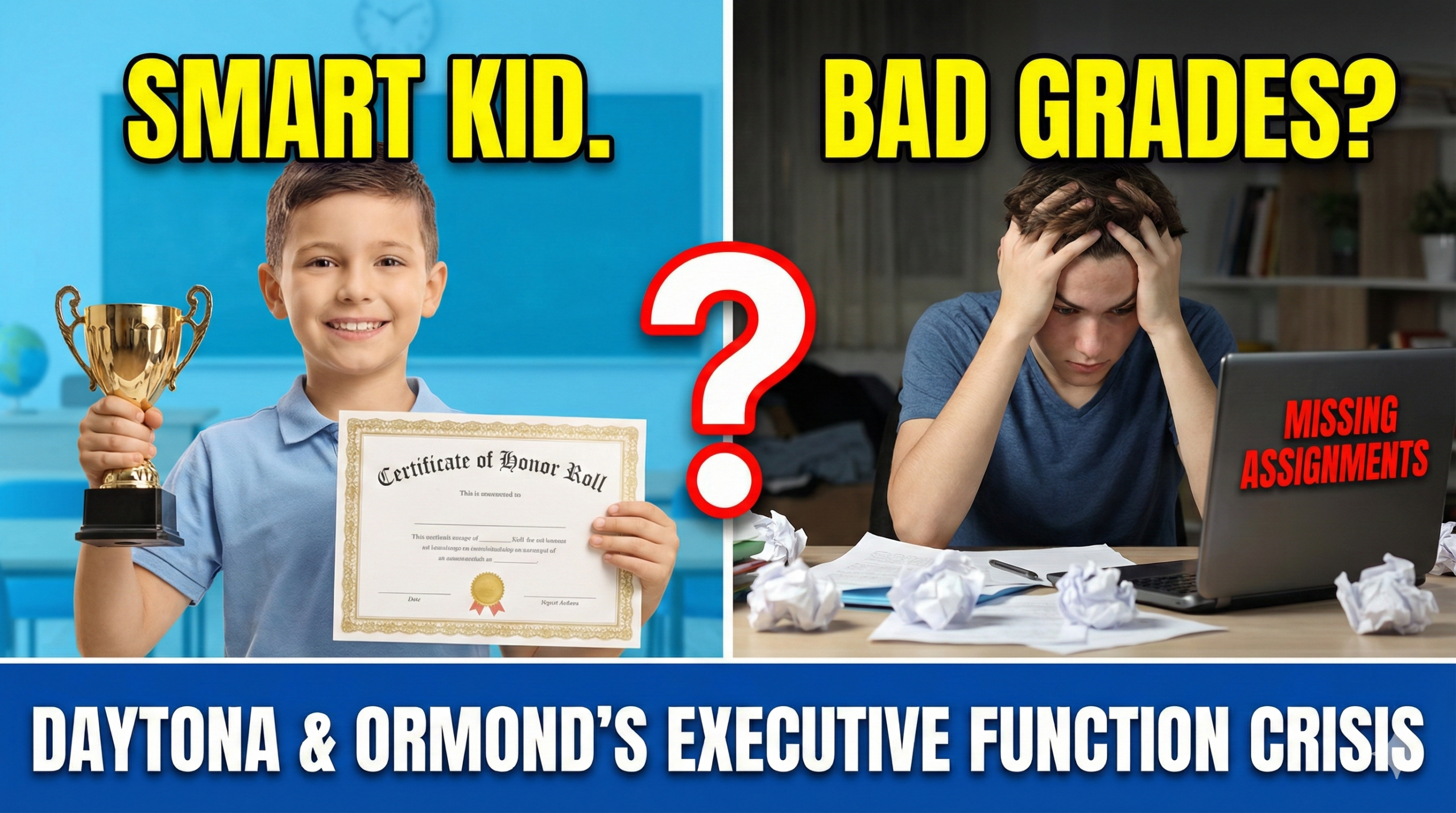
Smart Kid, Bad Grades? The “Executive Function” Crisis in Daytona & Ormond Schools
It is a frustrating mystery for parents in Ormond Beach and Port Orange: Your child is smart. They can hold a conversation about complex topics, they ace their video games, and they might even test in the 90th percentile.
But look at their backpack, and it’s a graveyard of crumpled worksheets. Look at their online portal, and it’s a sea of “Missing” assignments. Ask them if they have homework, and the answer is always, “I did it already” (spoiler: they didn’t).
If this sounds familiar, you aren’t dealing with a laziness problem. You are dealing with an Executive Function crisis. For families seeking tutoring in Daytona and Ormond, this is becoming the number one reason for outreach. In the high-pressure academic environment of Volusia County—from the Spruce Creek IB program to the rigorous dual enrollment tracks at Embry-Riddle—this invisible deficit is causing brilliant students to crash and burn.
Here is why your “smart but scattered” student is struggling—and how to help them get back on track.
The “CEO” of the Brain is Out to Lunch
Think of the brain like a company. Intelligence (IQ) is the talent—the engineers and creatives who come up with great ideas. Executive Function is the CEO. It is the part of the brain responsible for planning, time management, working memory, and impulse control.
For many students in our area, the “Talent” (IQ) is high, but the “CEO” is absent. Throughout elementary school—perhaps at Tomoka or Pine Trail—their intelligence was enough to coast. They didn’t need to study or organize because they absorbed the material instantly.
But when they hit middle school or the demanding high school magnet programs, “smart” is no longer enough. The workload requires a CEO. When one isn’t there, the grades plummet. This is often where we see gaps open up, not just in organization, but in specific subjects. A student might understand the concepts perfectly but fail because they lost the packet, leading to a sudden need for math tutoring simply to catch up on missing work.
Key Takeaways:
-
It’s Biological: Executive Function skills reside in the prefrontal cortex, which doesn’t fully develop until age 25.
-
The “Coast” is Over: Raw intelligence hides organization deficits until the workload increases.
-
The Gap: The gap between what they know and what they can show is the defining feature of executive dysfunction.
The Volusia County Pressure Cooker
Why does this seem so prevalent right now? Because the academic stakes in our local neighborhoods—from Ormond Terrace to Fiesta Heights—have never been higher.
Volusia County offers incredible opportunities, but they come with intense pressure. Students aiming for the IB program at Spruce Creek High or taking dual enrollment courses at Daytona State or Embry-Riddle are faced with a collegiate-level workload at age 15.
In these programs, a missed deadline is often a zero. For a student with weak executive function, this is catastrophic. We see this constantly with students who are brilliant thinkers but struggle to navigate the logistics of seven different teachers and online platforms. This disorganization often bleeds into their standardized testing preparation as well, making SAT and ACT prep incredibly difficult because they cannot stick to a study schedule.
Key Takeaways:
-
Complexity Overload: The shift from one teacher to seven is the breaking point for many.
-
The “Zero” Factor: Smart kids fail not because they get F’s on tests, but because they get Zeros on homework.
-
The Anxiety Loop: Disorganization leads to falling behind, which leads to anxiety, which leads to avoidance.
The “Screen-Time” Multiplier
We cannot talk about focus without talking about the device in their pocket. For a student with executive function deficits, a smartphone is kryptonite.
The algorithms of social media are designed to hijack the dopamine reward system. Expecting a teenager with developing executive skills to “just ignore” their phone is like expecting a dieter to ignore a donut placed in their hand.
For parents in Daytona and Ormond, the battle isn’t just against the schoolwork; it’s against the “Tech-Intentional” struggle. When a student sits down to work, every notification is a “task switch” that resets their focus. It takes an average of 23 minutes to regain deep focus after an interruption. If the phone buzzes every 10 minutes, deep work never happens.
Key Takeaways:
-
Dopamine Seeking: Disorganized brains crave the “quick hit” of a screen over the “slow burn” of an essay.
-
Task Switching: Multitasking is a myth; it’s actually rapid task-switching that degrades performance by 40%.
-
Visual Cues: If the phone is visible, it is draining cognitive resources.
The Solution: Scaffolding, Not Nagging
So, what do you do? The natural instinct for parents is to become the “External CEO.” You remind them, you check their portal, you pack their bag. This is called “The Nag Cycle,” and it destroys the parent-child relationship while solving nothing.
The goal of professional study and organizational skills tutoring is not to do the work for the student, but to build the scaffolding they need to do it themselves.
Effective intervention looks like this:
-
The “Sunday Meeting”: A 15-minute sync to look at the week ahead, not the grades behind.
-
Chunking: Breaking a scary 5-page paper into ten small, non-scary steps.
-
Body Doubling: Having a tutor simply present while the student works can drastically reduce task initiation anxiety.
-
Analog Tools: We often encourage paper planners because they don’t have an App Store attached to them.
For our students in Port Orange and beyond, this shift is transformative. When a student realizes, “I’m not stupid, I just needed a system,” the confidence returns instantly.
Key Takeaways:
-
Outsource the Enforcer: Let a tutor be the “bad guy” about deadlines so you can go back to being Mom or Dad.
-
Process over Product: Praise the strategy used (starting early, making a list) rather than just the grade.
-
Visuals Matter: Time is abstract; use analog clocks and physical lists to make it concrete.
Conclusion: Building Skills for College
The goal of addressing Executive Function isn’t just to survive 10th-grade Chemistry. It is to ensure that when your child eventually lands at Embry-Riddle, UCF, or Daytona State, they don’t crash in their first semester.
Colleges do not call parents to remind them about due dates. The skills we build today—organization, self-advocacy, time management—are the skills that will keep them enrolled tomorrow. Don’t wait for the report card to be a disaster. If you see the signs of the “Smart but Scattered” student, contact us today. We can help build the systems your student needs to succeed.
Helpful Resources: