
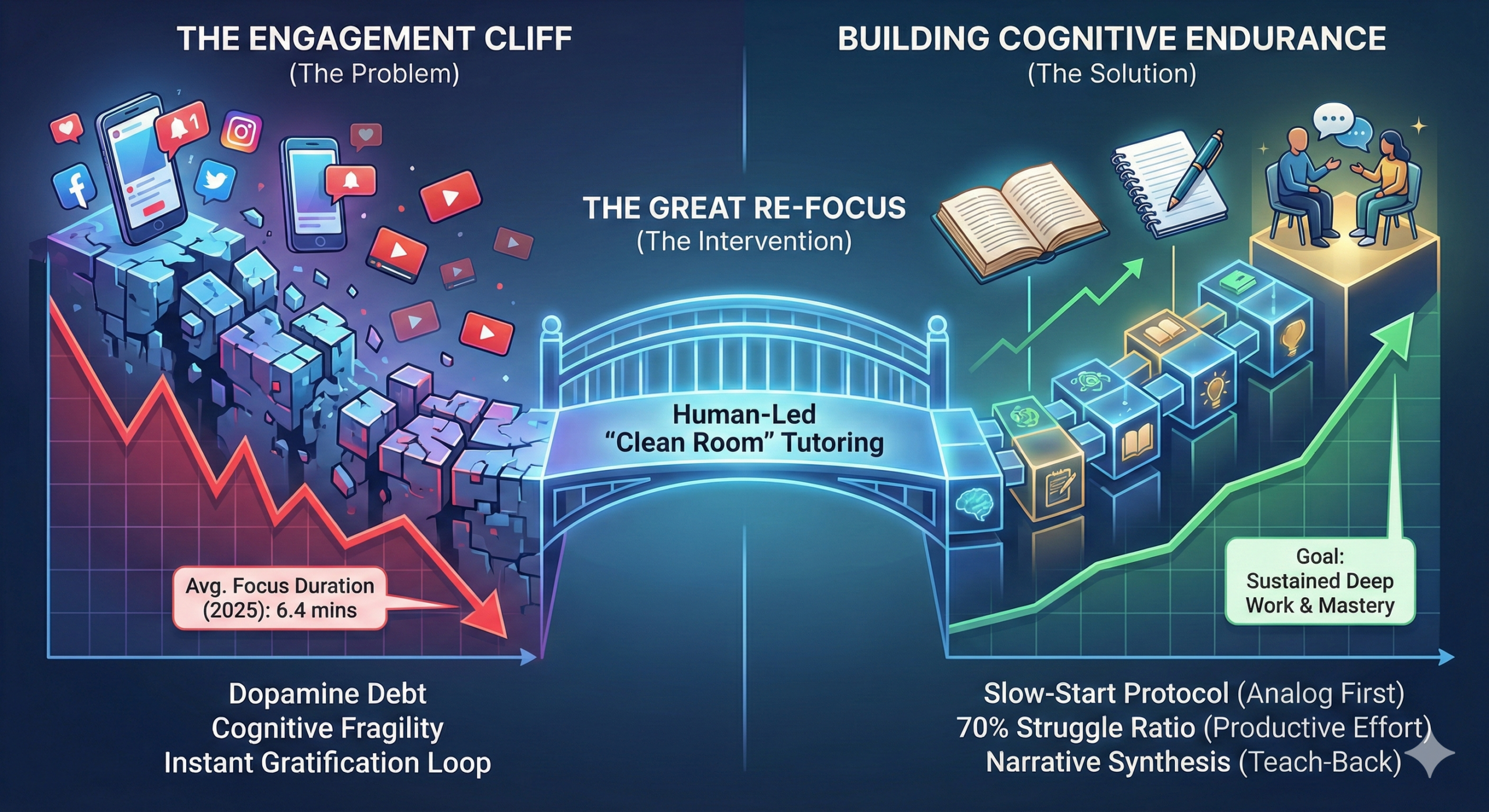
TLDR: In 2026, students are hitting an “Engagement Cliff”—a sharp decline in academic motivation driven by the fractured attention economy. While AI provides instant answers, it often bypasses the cognitive struggle required for true learning. The Tutoring Company explores why high-touch, human-led mentorship is the only remaining “clean room” for Deep Work, turning focused attention into the new academic luxury.
Table of Contents
-
The Silent Crisis: Defining the 2026 Engagement Cliff
-
The Infrastructure of Distraction: Why Phone Bans Aren’t Enough
-
The Dopamine Debt: Understanding the Neurochemistry of the Modern Student
-
Tutoring as a “Clean Room” for Deep Work
-
The Cognitive Endurance Gap: The New Metric for Success
-
A Roadmap for the Great Re-Focus
1. The Silent Crisis: Defining the 2026 Engagement Cliff
For decades, educators observed a gradual slide in student motivation as they moved from the curiosity-driven years of elementary school into the performance-driven grind of high school. But in 2026, that slide has become a precipice. We call it the Engagement Cliff.
It is the moment—often occurring between the 7th and 9th grades—where the friction of academic effort loses its battle against the frictionless ease of the digital world. When a student can generate a passable essay in seconds or find the solution to a complex calculus problem with a quick scan of an app, the biological imperative to struggle with a concept evaporates.
The Engagement Cliff isn’t a lack of intelligence; it is a lack of intent. At The Tutoring Company, we are seeing a generation of students who are “academically hyper-efficient” but “cognitively fragile.” They can produce results, but they cannot sustain the long-form attention required to master a discipline.
The Data Point: A 2025 study on adolescent cognitive load found that the average duration of “uninterrupted focus” on a single academic task has plummeted to just 6.4 minutes, down from 12 minutes in 2019.
2. The Infrastructure of Distraction: Why Phone Bans Aren’t Enough
The headline-grabbing “Great Phone Ban” of 2025-2026 was a necessary first step. Removing the physical device from the classroom has undoubtedly lowered the ambient noise of the school day. However, we are discovering that the “distraction” wasn’t just in the pocket; it was internal.
We have moved from an era of External Distraction to Internalized Fragmentation. Even without a phone on the desk, the student’s mind is conditioned for the “ping.” The expectation of a quick dopamine hit—the “instant solve”—is now the baseline cognitive state.
When a student sits down with a tutor today, the first five minutes are often spent in a state of cognitive withdrawal. They are waiting for the shortcut. They are looking for the “optimization” that allows them to move to the next thing. Reclaiming attention requires more than taking away a device; it requires rebuilding the infrastructure of the student’s internal environment.
3. The Dopamine Debt: Understanding the Neurochemistry of the Modern Student
To understand why a student “checks out” when faced with a difficult physics proof, we must look at the neurochemistry of learning. Mastery requires a state of Flow, which is metabolically expensive. It requires the brain to suppress distractions and maintain a high-energy state of focus.
In the age of the Engagement Cliff, students are living in a state of Dopamine Debt. Their reward systems are so saturated by high-frequency digital inputs that the slow, steady reward of solving a math problem or finishing a novel feels like a deficit.
Breakout: The 1:1 Focus Advantage
In a classroom of 30, a student can hide in the “blind spots” of the teacher’s attention. In a 1:1 tutoring session, there is nowhere for the attention to leak. This “forced presence” is the first step in recalibrating the brain’s reward system.
4. Tutoring as a “Clean Room” for Deep Work
If the modern world is a “noisy room” of infinite inputs, then the tutoring session must become a “Clean Room.” Borrowing from Cal Newport’s concept of Deep Work, we believe the future of high-end education isn’t about what is being taught, but the environment in which it is learned. The Tutoring Company is no longer just a source of subject-matter expertise; we are Attention Architects.
In a “Clean Room” environment, the tutor acts as the external prefrontal cortex for the student. They provide the guardrails that prevent the mind from drifting. They normalize the frustration of “the stick point”—that moment when a problem gets hard and the student’s instinct is to reach for a shortcut. By staying in that frustration together, the tutor helps the student build the neural pathways necessary for endurance.
5. The Cognitive Endurance Gap: The New Metric for Success
In the 2020s, success was measured by GPA and test scores. In the late 2020s, those metrics are being disrupted by AI. If anyone can get an A, then the “A” no longer differentiates.
The new differentiator in 2026 is Cognitive Endurance. Can the student sit with a complex, ambiguous problem for two hours without checking out? Can they read a 40-page primary source and synthesize a unique argument that isn’t a regurgitation of a Large Language Model?
We are seeing a widening gap between those who can “perform” (use tools to get an answer) and those who can “think” (sustain focus to build a model). The latter is becoming the ultimate luxury good in the professional world.
6. A Roadmap for the Great Re-Focus
How do we help a student scale the Engagement Cliff? It requires a strategic shift in how we approach “after-school help.”
-
The “Slow-Start” Protocol: We begin sessions with five minutes of “analog entry.” No screens, no tablets—just a pen, a piece of paper, and a single goal.
-
The Struggle Ratio: A tutor’s job is to ensure the student stays in the “zone of productive struggle” for at least 70% of the session. If it’s too easy, they aren’t building endurance. If it’s too hard, they trigger the “exit” response.
-
Narrative Synthesis: Instead of multiple-choice or short-answer, we ask students to “teach back” the concept. AI can’t fake the nuances of a human-to-human explanation.
The Conclusion: The Human Element as the High-Ground
As we move further into 2026, the “Engagement Cliff” will continue to claim those who rely solely on the frictionless path. But for those who invest in the “Great Re-Focus”—who prioritize human-led, deep attention over commodity AI—the rewards will be immense.
At The Tutoring Company, we aren’t just teaching subjects; we are teaching the most valuable skill of the 21st century: The ability to pay attention.