
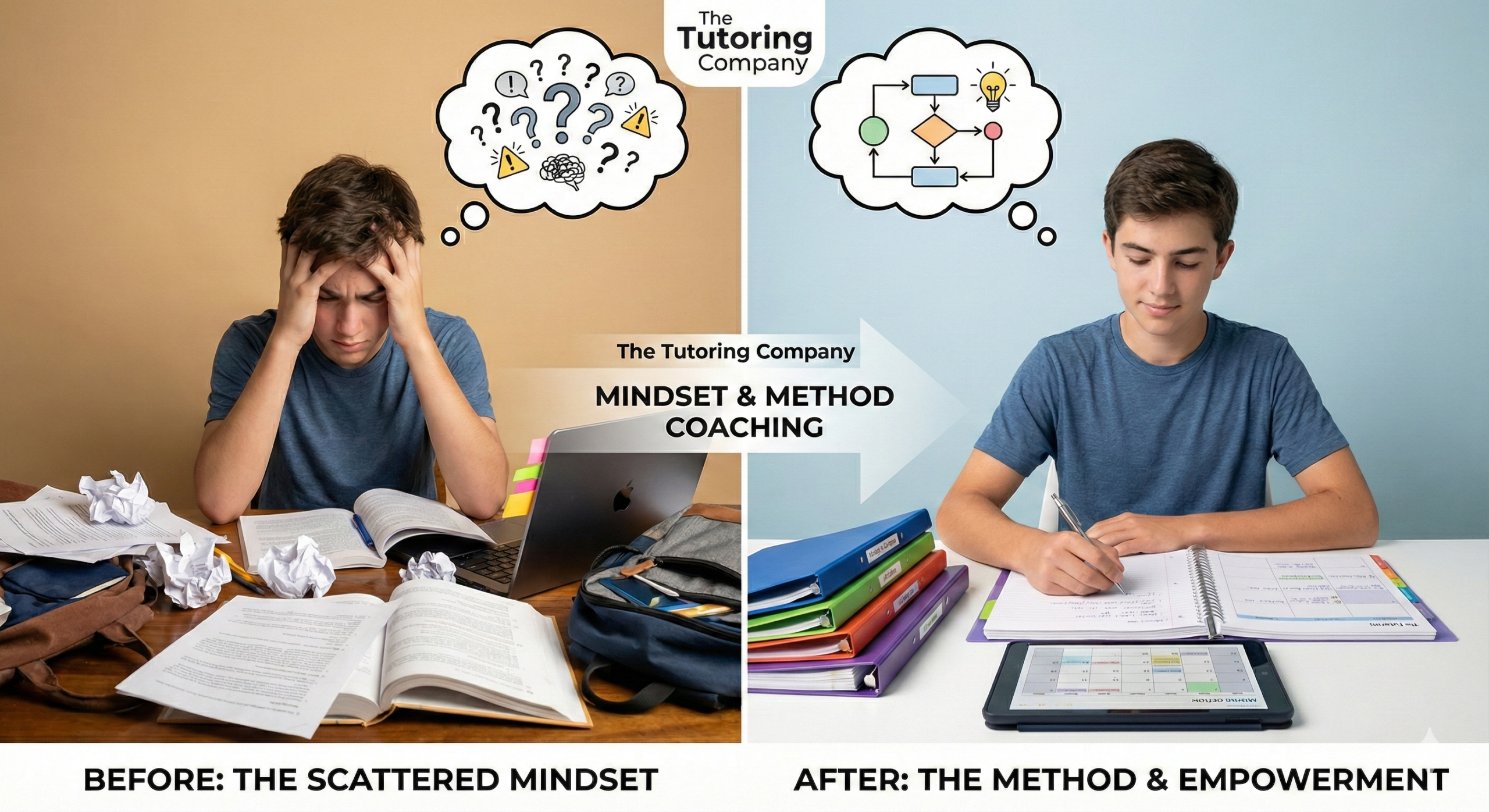
You know your child is smart. They can articulate complex ideas at the dinner table, build intricate projects, and debate nuanced topics. Yet, when you log into their school portal, the screen is a sea of missing assignments, zeros for homework left in the bottom of a backpack, and points deducted for late submissions.
This is the “smart but scattered” paradox.
For decades, parents have reacted to this academic drop-off by hiring a traditional subject tutor. If the grade in math is low, hire a math tutor. But what if the problem isn’t that your child doesn’t understand Algebra? What if the problem is that they don’t know how to track assignments, organize their binder, or manage the anxiety of an approaching deadline?
At The Tutoring Company, we recognize that academic success requires more than just content knowledge. It requires a system. Through our Mindset and Method coaching, we provide holistic tutoring designed to build the critical executive functioning skills that fall outside the scope of traditional education.
Here is why your student might need an executive function coach, and how building an academic process transforms not just their grades, but their entire mindset.
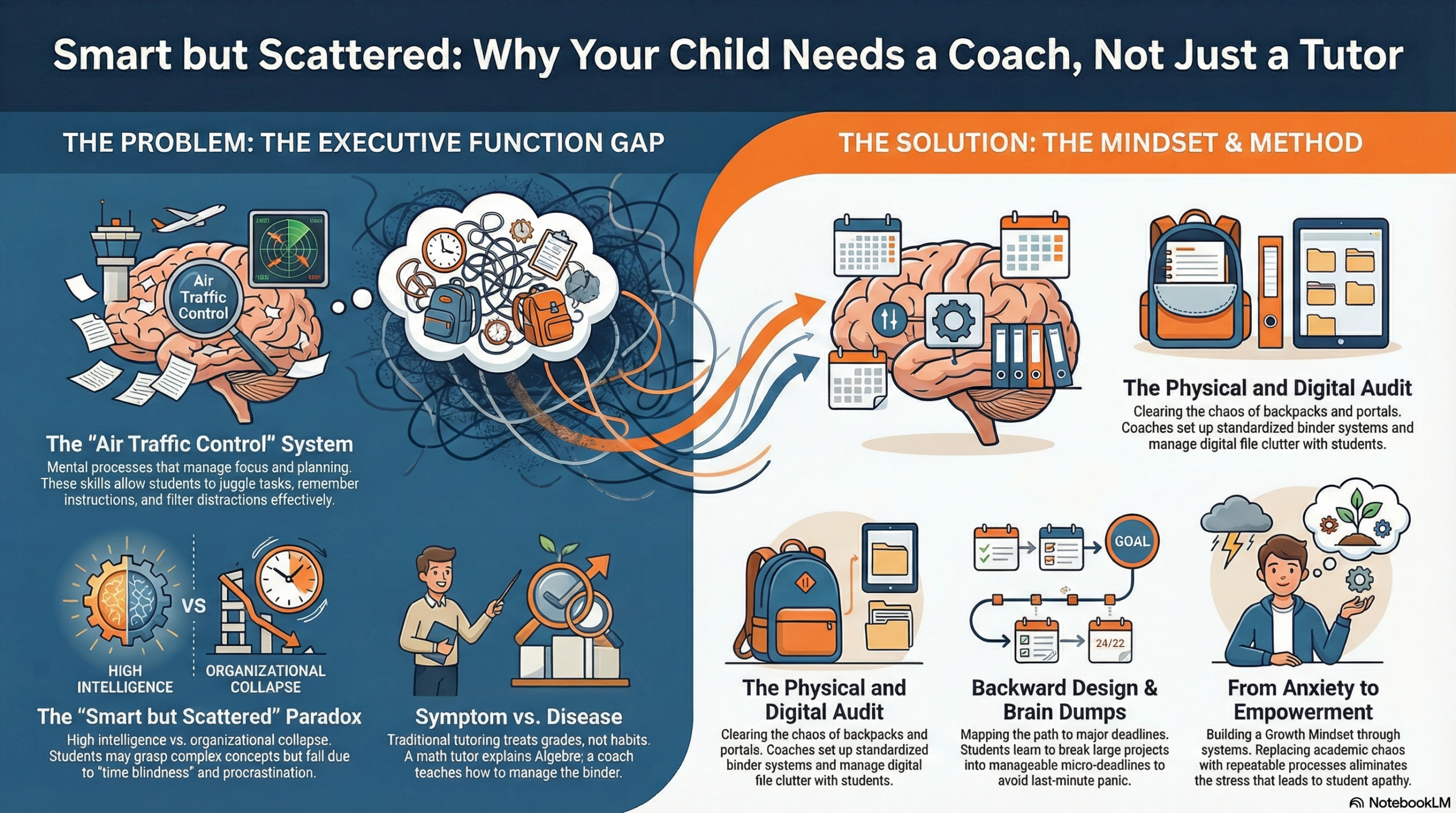
Table of Contents
-
The Diagnosis: What is Executive Function?
-
Why Traditional Tutoring Fails the Disorganized Student
-
The Mindset and Method Approach: What is Holistic Tutoring?
-
Process Building: The Mechanics of Academic Coaching
-
The Mindset Shift: From Anxious to Empowered
-
Frequently Asked Questions (FAQ)
The Diagnosis: What is Executive Function?
Before we can fix the academic slide, we have to identify the root cause. Often, the culprit is a delay or deficit in executive functioning.
According to the Harvard University Center on the Developing Child, executive function and self-regulation skills are the mental processes that enable us to plan, focus attention, remember instructions, and juggle multiple tasks successfully. You can think of these skills as the “air traffic control system” of the brain.
When a student’s air traffic control system is overwhelmed, the planes crash. In an academic setting, executive dysfunction looks like this:
-
Working Memory Deficits: Forgetting multi-step directions immediately after the teacher gives them.
-
Task Initiation Failure: Staring at a blank Google Doc for an hour because starting the essay feels too overwhelming.
-
Poor Time Management: Believing a massive science project will “only take an hour” and starting it at 9:00 PM the night before it is due.
-
Organizational Collapse: Shoving loose papers into a backpack instead of utilizing a structured binder system.
The Child Mind Institute notes that executive functioning issues become most apparent during transitions—such as the jump from elementary to middle school, or middle school to high school—when the scaffolding of having one teacher all day is suddenly removed.
Why Traditional Tutoring Fails the Disorganized Student
When a student brings home a “D” in Biology, the instinct is to hire a Biology tutor. A traditional tutor will sit down, review the Krebs cycle, help the student complete the worksheet, and leave.
The student understands the Krebs cycle perfectly that evening. But three days later, that completed worksheet is crumpled in the bottom of a locker, the student forgets to turn it in, and the “D” remains.
Traditional tutoring is designed to treat the symptom (a lack of specific content knowledge). It is not designed to treat the disease (a broken academic process).
As highlighted by Understood.org, students with weak executive function don’t need someone to simply do the homework with them; they need someone to teach them how to do school. Without addressing the underlying organizational chaos, even the best subject tutoring is a temporary bandage.
If your child is struggling to stay afloat, relying on a purely academic tutor is an incomplete strategy. This is why a shift toward a more comprehensive model is necessary.
The Mindset and Method Approach: What is Holistic Tutoring?
Holistic tutoring is an educational philosophy that views the student as a whole person, rather than just a vessel for math or reading facts. It acknowledges that academic performance is intrinsically linked to mental organization, emotional regulation, and self-confidence.
At The Tutoring Company, our Mindset and Method coaching is built on this holistic framework. We deploy specialized study skills tutors who act as academic project managers for your child.
We do not just ask, “Did you do your homework?” We ask:
-
“Where is your homework recorded?”
-
“How are you breaking down this project over the next five days?”
-
“What is your strategy for communicating with your teacher about this missing grade?”
Holistic tutoring bridges the gap between raw intelligence and practical execution. It removes the friction from the learning process, allowing the student’s natural intelligence to actually translate into their GPA.
Process Building: The Mechanics of Academic Coaching
Executive function coaching is highly actionable. It is about building rigid, repeatable systems that a student can rely on when they feel overwhelmed. Edutopia emphasizes that these skills must be explicitly taught and practiced; they do not simply develop on their own.
Here is what the “Method” portion of our coaching looks like in practice:
1. The Digital and Physical Audit
We begin by auditing the student’s current organizational disaster. We clear out the backpack, set up a standardized binder system, and conduct a digital audit of their Google Drive and Canvas/Blackboard portals. We teach them how to name files properly and manage digital clutter.
2. Time Management and The “Brain Dump”
Many students with executive dysfunction suffer from “time blindness”—an inability to accurately judge how long a task will take, a concept widely discussed in resources like ADDitude Magazine. We teach students how to perform a weekly “brain dump,” getting every assignment and anxiety out of their head and onto a physical or digital calendar.
3. Syllabus Mapping and Backward Design
When a high schooler gets a syllabus, they often ignore it. An executive function coach teaches the student how to use backward design: looking at a final exam or project due date and working backward to set micro-deadlines for reading, outlining, and drafting.
4. Active Study Strategies
Staring at a textbook for three hours is not studying; it is reading. Our tutors teach active study skills—such as the Pomodoro technique, spaced repetition, and the Feynman technique—which are vital components of effective test preparation.
The Mindset Shift: From Anxious to Empowered
The most profound result of our Mindset and Method coaching isn’t just a cleaner backpack; it is a total psychological transformation.
When a student lacks executive functioning skills, they exist in a perpetual state of academic anxiety. They are always waiting for the other shoe to drop—a forgotten test, a zero in the grade book, a disappointed look from a parent. Over time, this anxiety hardens into apathy. The student decides, “I’m just bad at school,” and stops trying.
By building processes, we eliminate the chaos. When the chaos is gone, the anxiety dissipates.
This is the “Mindset” half of our approach. As students see their new systems working, they begin to develop a growth mindset. They learn that they are not inherently “lazy” or “bad at math.” They simply lacked the proper tools.
In-person tutoring provides the ideal environment for this mentorship. Having a neutral third party—someone who isn’t a parent or a grading teacher—hold them accountable builds academic confidence and resilience that carries over into college and their future career.
Frequently Asked Questions (FAQ)
Q: What is the difference between a traditional tutor and an executive function coach? A: A traditional tutor focuses on what to learn (e.g., specific math formulas or history dates). An executive function coach focuses on how to learn, teaching skills like time management, organization, task initiation, and long-term planning.
Q: At what age should my child start holistic academic coaching? A: We highly recommend beginning study skills and organizational coaching during critical transition years, such as 6th grade (entering middle school) or 9th grade (entering high school). However, it is never too late for high schoolers to build these systems.
Q: How do I know if my child has executive dysfunction or is just being lazy? A: “Laziness” is often a mask for feeling overwhelmed. If your child is highly capable but consistently misses deadlines, loses papers, forgets instructions, and experiences extreme procrastination, they are likely struggling with executive function, not a lack of desire.
Q: Can your tutors help with standardized tests as well? A: Yes. The same executive functioning skills that help a student manage a semester workload are highly applicable to standardized test prep, where pacing, emotional regulation, and systematic problem-solving are required.
Ready to Fix the Process?
Stop treating the symptoms and start solving the root problem. If you are tired of fighting over missing assignments and disorganized backpacks, it is time to shift your approach.
The Tutoring Company’s Mindset and Method coaching gives your student the organizational tools and the academic confidence they need to succeed independently.
Contact us today to schedule a consultation and match your student with an expert executive function and study skills coach in your area.