
Table of Contents
-
Introduction: The Missing Piece of the Academic Puzzle
-
What Exactly is Executive Function?
-
The Three Core Pillars of Executive Function
-
Recognizing the Signs: Does Your Child Need EF Tutoring?
-
Traditional Tutoring vs. Executive Function Coaching
-
Proven Strategies Used by Our Coaches
-
The Long-Term Benefits of Building Executive Skills
-
Local Support: The Tutoring Company Advantage
-
Conclusion: Ready to Transform Your Student’s Year?
-
Frequently Asked Questions (FAQs)
Introduction: The Missing Piece of the Academic Puzzle
Have you ever watched an incredibly bright, highly capable student stare blankly at a disorganized backpack, completely unsure of how or where to start their homework? Or perhaps you’ve witnessed the tense evening meltdown that reliably occurs when a massive, long-term project is due the very next morning, and it hasn’t even been started. If these scenarios sound altogether too familiar, you are certainly not alone.
Here at The Tutoring Company, we sit down with frustrated parents every single week who watch their children struggle. The friction usually isn’t with the actual academic material they are learning—they understand the history concepts and the math formulas—but rather with the process of learning itself. This is where the vital concept of executive function comes into play. It is arguably the single most critical component of sustained academic success, yet it is rarely explicitly taught in a standard classroom setting.
In our fast-paced, digital-first world, middle and high school students are being asked to manage more information, more notifications, and more complex schedules than any generation before them. As parents and educators, we often assume that kids will simply “figure out” how to organize their time, study effectively, and manage their focus as they grow older. However, for a significant percentage of students, these essential life skills do not develop automatically. They require direct, explicit instruction and ongoing, heavily supervised practice. This is exactly where our specialized executive function tutoring steps in, bridging the painful gap between a student’s raw, natural intelligence and their operational ability to execute tasks efficiently.
What Exactly is Executive Function?
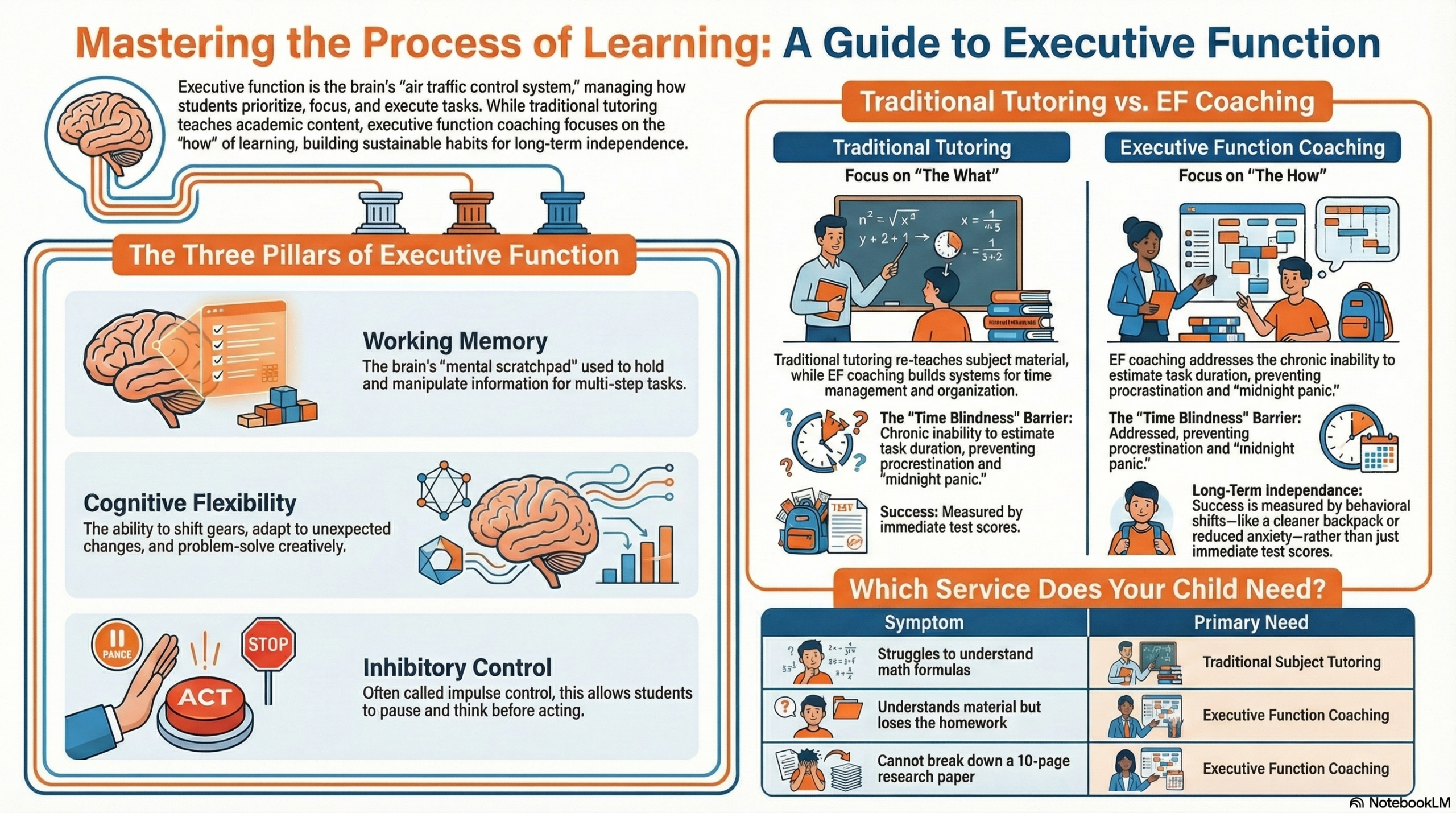
To truly understand why some students struggle so profoundly with organization, prioritization, and time management, we have to look closely at how the human brain manages complex tasks. Experts and neuroscientists frequently compare executive function to the air traffic control system at a busy international airport. Imagine dozens of commercial planes taking off, landing, and taxiing on the runways all at the exact same time. Without a highly trained air traffic controller to manage the flow, prioritize the runways, and prevent catastrophic collisions, total chaos would immediately ensue.
The human brain operates in a very similar manner, as extensively noted by the Harvard Center on the Developing Child. Executive function is the biological cognitive control system located in the prefrontal cortex. It allows us to filter out background distractions, prioritize pressing tasks, set realistic goals, and control our immediate impulses in favor of long-term rewards.
When a student’s internal “air traffic control system” is functioning smoothly, they can seamlessly transition from finishing math homework to practicing the piano. They can actively resist the dopamine-driven urge to scroll through social media when they should be studying for a biology midterm. When there is a neurodevelopmental breakdown or delay in this system, however, even the simplest daily routines can feel completely insurmountable. This isn’t a matter of laziness, defiance, or a lack of caring. It is a genuine, documented challenge that requires the kind of structured, empathetic support we provide at The Tutoring Company.
The Three Core Pillars of Executive Function
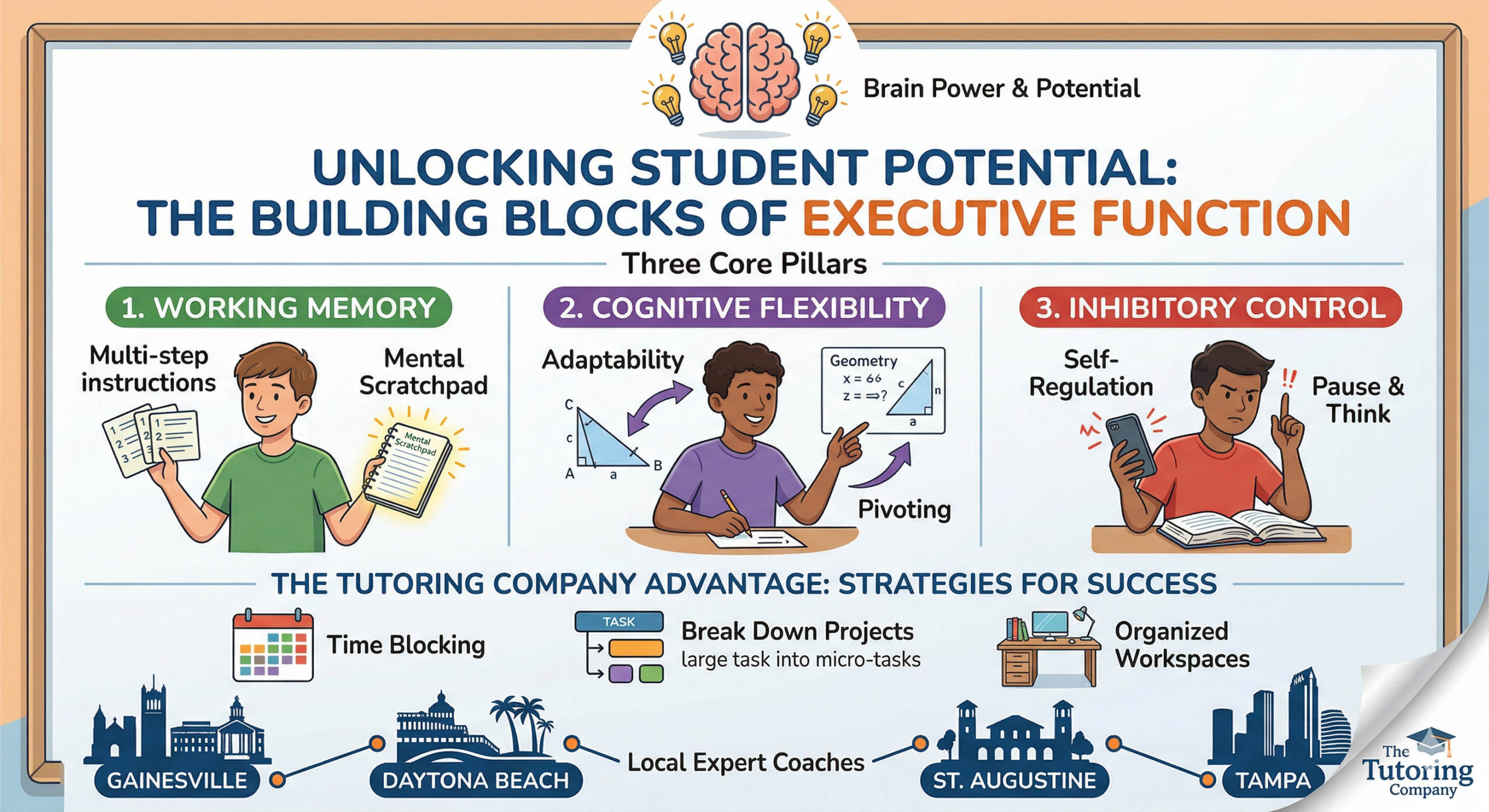
Neuropsychologists and special education experts generally agree that executive function is built upon three primary, interlocking cognitive pillars. When one of these pillars is weak, the entire structure of a student’s academic life can begin to lean.
The first of these is working memory. Working memory is essentially the brain’s mental scratchpad. It is the ability to hold onto pieces of information over short periods of time and actively manipulate them to solve a problem. For example, remembering a multi-step direction from a teacher (“Put away your textbooks, take out a sharpened pencil, and open your workbooks to page forty-two”) relies entirely on working memory. Students with weak working memory often seem incredibly forgetful, lose their belongings frequently, and struggle to follow complex, multi-layered instructions without getting lost halfway through.
The second pillar is cognitive flexibility. This is the brain’s ability to shift gears, pivot, and adapt to new information or unexpected changes in circumstances. It is what allows a student to seamlessly transition from recess back into a quiet classroom environment, or to try a completely different approach to solving a geometry problem when their first attempt fails. Students who lack cognitive flexibility often appear rigid in their thinking. They might become easily frustrated by sudden changes in their daily routine or get completely “stuck” on a specific idea. You can find excellent, practical resources on managing these difficult transitions at Understood.org.
The third and final core pillar is inhibitory control, which is frequently referred to as impulse control or self-regulation. This is the crucial ability to pause and think before acting. In a classroom, inhibitory control is what stops a student from blurting out an answer out of turn or getting out of their seat during a quiet reading period. Strengthening these three specific pillars is the fundamental goal of any effective executive function intervention.
Recognizing the Signs: Does Your Child Need EF Tutoring?
So, how can you definitively tell if your child might genuinely benefit from executive function tutoring rather than simply needing a little extra help with their algebra homework? The signs of executive dysfunction are often pervasive, chronic, and show up across multiple areas of a student’s life.
One of the most glaring red flags is a chronic inability to estimate how long tasks will actually take, an issue frequently highlighted by the Child Mind Institute. A student might genuinely believe that a ten-page research paper can be researched, drafted, and edited in an hour. This phenomenon, known as “time blindness,” inevitably leads to severe procrastination and midnight panic.
Another incredibly common sign is the infamous “black hole” backpack. If you routinely find crumpled, ungraded assignments, missing permission slips, and weeks-old snacks at the absolute bottom of your child’s bag, their physical organizational systems are failing them. You might also notice a highly frustrating pattern of inconsistent performance. A student might ace a highly complex unit test one week because the topic interested them, but completely fail to turn in three simple, daily homework assignments the next week.
If you are noticing these exhausting patterns, a traditional subject tutor won’t solve the root of the problem. You need a specialized, targeted approach. You can explore our foundational support systems and coaching frameworks through The Tutoring Company’s homepage.
Traditional Tutoring vs. Executive Function Coaching
It is crucial for parents and educators to understand the stark difference between traditional subject-matter tutoring and specialized executive function coaching. At The Tutoring Company, we proudly offer both, because we know from years of experience that they serve entirely different purposes.
If a student is fundamentally struggling to grasp the rules of Spanish grammar, balancing chemical equations, or understanding historical timelines, our traditional subject-area tutors are the perfect solution. They will re-teach the material, provide practice problems, and clarify academic misunderstandings.
However, if a student understands the material perfectly well but routinely forgets to bring their textbook home, loses their completed worksheets on the way to first period, or cannot maintain focus long enough to finish a standard twenty-minute assignment, a traditional tutor is only a temporary band-aid.
Executive function tutoring does not focus on the what of learning; it focuses entirely on the how. Our EF coaches work collaboratively with students to build customized, sustainable systems for organization, time management, and self-advocacy. Major advocacy groups like CHADD heavily emphasize the importance of targeting this “how” to foster lasting academic resilience.
Proven Strategies Used by Our Coaches
When a student begins working with an executive function coach at The Tutoring Company, the process always starts with a comprehensive assessment of their current habits, natural strengths, and specific areas of friction. We aren’t here to hand down a rigid, one-size-fits-all set of unbending rules. Instead, our coaches co-create strategies that actually resonate with the student’s unique neurobiology.
One heavily utilized strategy is the concept of “time blocking” and visual scheduling. Because students with EF challenges suffer from time blindness, our tutors introduce analog clocks, highly visual timers, and color-coded digital calendars to make time a tangible, visible concept. We teach students exactly how to break down massive, overwhelming projects into tiny, manageable micro-tasks with their own individual deadlines.
Another core strategy involves a complete overhaul of physical and digital organization. We help students declutter workspaces, establish logical, easily maintainable filing systems for Google Drive or OneDrive, and create specific “launch pads” near the front door where all necessary items are gathered the night before. To see exactly how these proven strategies are integrated into our personalized learning plans, you can explore our comprehensive tutoring services.
The Long-Term Benefits of Building Executive Skills
The ultimate, overarching goal of executive function tutoring at The Tutoring Company is not simply to help a student survive the current semester or pass their upcoming final exams. The true goal is to build long-term, sustainable independence. The skills developed through our intensive coaching—long-term planning, emotional regulation, cognitive flexibility, and sustained attention—are the exact same soft skills that are highly prized in the adult workforce, as reported by major educational outlets like Edutopia.
When a student finally masters these skills, the transformation is profound. The constant, grinding friction between parents and children over homework dissipates. The student’s self-esteem begins to naturally heal as they experience true, unassisted success. They stop viewing themselves as “broken” and begin to view themselves as highly capable individuals equipped with the right tools.
Local Support: The Tutoring Company Advantage
Finding highly qualified, empathetic support for your child’s executive function needs shouldn’t add to your parental stress. Building a strong foundation requires consistency, and having local, accessible experts makes all the difference in the world.
Because our team is deeply embedded in our local Florida communities, our coaches intimately understand the specific academic landscapes, testing requirements, and district portals our students are navigating. Whether your family needs a dedicated academic coach in Gainesville, support navigating the competitive school systems in Daytona Beach or St. Augustine, or high-level, personalized intervention in Tampa, The Tutoring Company has you covered. We don’t just teach academic skills in a vacuum; we adapt our targeted coaching directly to your student’s local school district expectations and personal life rhythm.
Conclusion: Ready to Transform Your Student’s Year?
Executive function challenges can often feel like an invisible barrier standing between your child and their true, untapped potential. Because these daily struggles don’t look like traditional learning disabilities, they are easily misunderstood by teachers and peers. But with patience, the right strategies, and expert, compassionate guidance, that internal “air traffic control system” can absolutely be optimized.
Investing in executive function coaching with The Tutoring Company is a direct investment in your child’s lifelong autonomy. It’s about equipping them with the master keys to unlock their own success, long after they have graduated from high school or college.
Take Action Today If you are ready to help your student transition from chaotic, disorganized, and overwhelmed to confident, prepared, and capable, it is time to take the next step. Let’s build a better, more organized tomorrow together.
Reach out to The Tutoring Company today to schedule your comprehensive consultation. Visit our Contact Page or email our direct strategy team at zach@thetutoringwebsite.com to get started!
Frequently Asked Questions (FAQs)
1. At what age should a child start executive function tutoring? While these vital skills begin developing during early childhood, specialized academic coaching is typically most effective starting in late elementary or middle school (around ages 10-12). This is exactly when the academic demands for independent project work and managing multiple, distinct class assignments increase significantly, making existing deficits much more apparent.
2. Is executive function tutoring only for kids with ADHD? Not at all. While essentially everyone with an ADHD diagnosis experiences executive function challenges, many students without ADHD also fundamentally struggle with these specific cognitive skills due to anxiety, specific learning differences, or simply a slower developmental trajectory in the prefrontal cortex.
3. How long does it typically take to see results with The Tutoring Company? Executive function tutoring is a meticulous, deliberate process of rewiring deeply ingrained habits. Parents usually begin to see noticeable improvements in daily routines and decreased household friction within 8 to 12 weeks. However, building lasting, permanent independent habits can often take a full academic year of consistent practice.
4. Can parents act as executive function coaches for their own children? While parents play a crucial supportive and encouraging role, the emotional baggage and natural power dynamics inherent in the parent-child relationship almost always cause friction when trying to enforce new systems. A neutral, highly trained third-party tutor from our team provides an objective environment where a student is much more receptive to changing their behavior.
5. How do I know if the tutoring is actually working? Success in EF tutoring is measured by behavioral shifts rather than just immediate test scores. You should look for fewer missing assignments in the parent portal, significantly reduced procrastination, a cleaner backpack, less nagging required to initiate homework, and a noticeable decrease in the student’s overall academic anxiety.