
1. The Academic & Clinical Landscape in Greater Daytona Beach
Throughout the Halifax area and East Volusia County—encompassing Port Orange, Ormond Beach, and Daytona Beach—academic ambitions are high. Driven by regional aerospace engineering industries tied to Embry-Riddle Aeronautical University, major healthcare systems including Halifax Health and AdventHealth, and expanding commercial corridors, local families place a premium on academic achievement and postsecondary readiness.
However, when a bright, curious student is diagnosed with Attention Deficit Hyperactivity Disorder (ADHD), conventional school environments often create significant stress. Families find themselves caught in an exhausting cycle of nightly homework battles, missing project deadlines, and unexpected drops in quarterly grades. Parents frequently see their child grasp complex discussions at home, only to receive poor marks in the classroom because multi-step directions were skipped, work was left unsubmitted, or time ran out on tests.
The Greater Daytona area features dedicated medical and therapeutic diagnostic centers, including the Halifax Health Child & Adolescent Behavioral Services and community resources like Easterseals Northeast Central Florida Explorer Academy. Yet clinical identification alone does not teach a student how to manage seven class periods, organize physical notebooks, or break down a 10-page research rubric. Bridging medical diagnosis into daily academic achievement requires specialized, in-home executive function and study skills coaching that aligns with how the neurodivergent brain operates.
2. Volusia County Neighborhoods & Communities We Serve
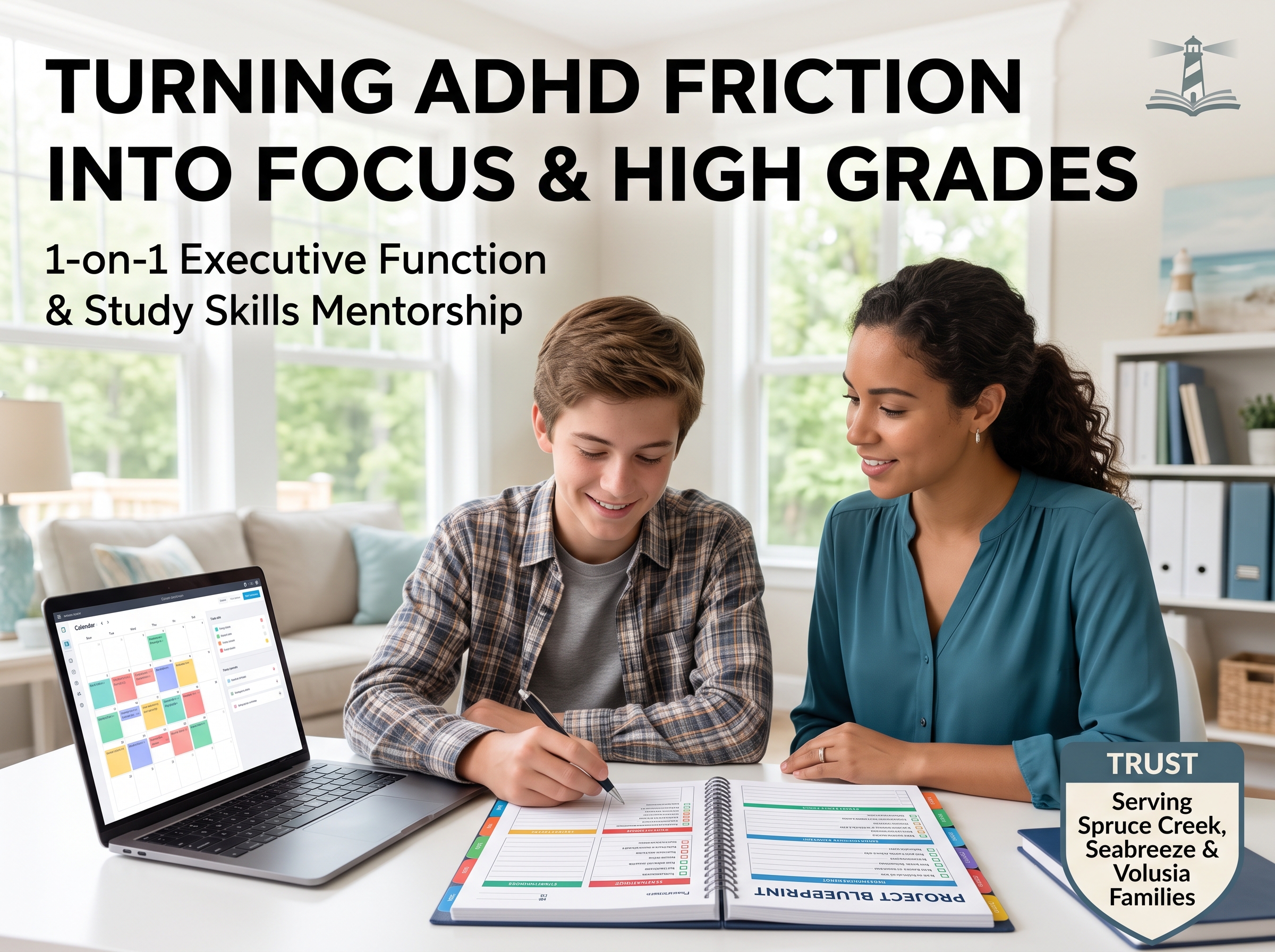
The Tutoring Company provides local, 1-on-1 private in-home and live virtual ADHD academic coaching across every major residential community in Greater Daytona and Southeast Volusia County. Our mentors meet students directly where they study, creating tailored homework management routines right at home:
Port Orange: Waters Edge & Cypress Head
Serving Waters Edge, Cypress Head, Town Park, Countryside, and the Airport Road corridor. We guide students attending Cypress Creek Elementary, Sweetwater, Creekside Middle, and Spruce Creek High School who need systems to balance demanding extracurricular schedules with accelerated coursework.
Ormond Beach: Plantation Bay & Tomoka
Serving Plantation Bay, Halifax Plantation, Hunters Ridge, and the Granada Boulevard corridor. Supporting students attending Pathways Elementary, Tomoka Elementary, Ormond Beach Middle, and Seabreeze High School who struggle with task initiation, physical clutter, and Canvas tracking.
Daytona Beach: Pelican Bay & LPGA Corridor
Serving Pelican Bay, the LPGA International golf community, and central Daytona. Providing structured coaching for students attending Campbell Middle School, Mainland High School, and Father Lopez Catholic High School.
Coastal & South Volusia Corridors
Serving families throughout Daytona Beach Shores, Ponce Inlet, and the Venetian Bay corridor in New Smyrna Beach whose students commute to regional magnet programs like Spruce Creek IB.
3. The Neurobiology of ADHD: Why Capable Students Experience Academic Friction
A persistent misconception is that ADHD is simply a behavioral issue characterized by physical restlessness or poor motivation. In reality, ADHD is a neurobiological condition centered in the prefrontal cortex—the brain’s executive control center. The prefrontal cortex manages the cognitive processes that allow individuals to plan sequential tasks, evaluate long-term outcomes, manage working memory, and maintain consistent focus.
       ┌─────────────────────────────────────────────────────────────┐
       │             THE EXECUTIVE FUNCTION IMPAIRMENT MODEL         │
       └─────────────────────────────────────────────────────────────┘
                                      │
         ┌────────────────────────────┼────────────────────────────┐
         ▼                            ▼                            ▼
  ┌──────────────┐             ┌──────────────┐             ┌──────────────┐
  │ WORKING      │             │ TASK         │             │ TIME         │
  │ MEMORY       │             │ INITIATION   │             │ BLINDNESS    │
  ├──────────────┤             ├──────────────┤             ├──────────────┤
  │• Retaining   │             │• Dopamine    │             │• Inability   │
  │  multi-step  │               deficiency   │               to gauge     │
  │  prompts     │             │• Overwhelmed │               pacing       │
  │• Cognitive   │               by complex   │             │• Procrastinate│
  │  dropouts    │               multitasking │               until panic  │
  └──────────────┘             └──────────────┘             └──────────────┘
The Dopamine Regulation Challenge
In the neurotypical brain, baseline dopamine levels allow individuals to sustain attention on low-stimulation tasks (like completing a history worksheet or reviewing algebra notes) because they can visualize the delayed reward of a good grade. In the ADHD brain, dopamine receptors operate with lower efficiency. Consequently, an ADHD student experiences low-stimulation tasks not merely as uninteresting, but as mentally draining. Without immediate urgency, novelty, or intense personal interest, the brain struggles to activate focus.
Working Memory & Cognitive Dropouts
Working memory acts as the brain’s mental whiteboard. For a student with ADHD, that whiteboard has limited capacity. When an instructor at Creekside Middle or Ormond Beach Middle delivers three sequential instructions (“Open your textbook to page 84, complete questions 3 through 9, and submit them through Canvas before the bell”), an ADHD student often loses the second and third steps while looking for a pen. When students are labeled “inattentive” or “careless,” their academic self-esteem suffers, leading to avoidance and burnout.
4. Elementary Foundations (K–5): Early Identification & Emotional Regulation
Elementary school establishes the core study habits for a child’s academic journey. In high-performing Volusia County elementary schools like Cypress Creek Elementary, Sweetwater Elementary, Horizon Elementary, and Pathways Elementary, expectations around classroom focus and reading independence increase quickly.
Signs of Executive Function Struggles in Grades K–5
- The Homework Stalemate: Spending two hours on a 20-minute spelling or math worksheet due to daydreaming, emotional meltdowns, or distraction.
- Backpack Clutter: Crumpled papers stuffed into the bottom of school bags; weekly agendas, permission slips, and completed worksheets lost before reaching the teacher.
- Difficulty Following Multi-Step Directions: Performing step one successfully, but stopping completely or beginning an unrelated task before completing steps two and three.
- Emotional Dysregulation: Significant frustration or tears when encountering unexpected academic challenges or transitioning from preferred to non-preferred activities.
Our elementary ADHD tutoring model uses visual checklists, physical manipulatives, color-coded folders, and positive reinforcement to build foundational routines. By addressing organizational friction early, we help students build confidence before the transition to middle school.
5. Middle School (6–8): Rotating Bell Schedules & The Disorganization Cliff
The move from 5th to 6th grade is often where students with ADHD experience their first academic drop. In elementary school, a single primary teacher maintains daily routines, monitors agenda books, and reminds students to turn in their assignments. In middle schools like Creekside Middle School, Silver Sands Middle School, Ormond Beach Middle, and Campbell Middle, that scaffolding disappears.
  ┌────────────────────────────────────────────────────────────────────────┐
  │                 THE MIDDLE SCHOOL DISORGANIZATION CLIFF                │
  └────────────────────────────────────────────────────────────────────────┘

    ELEMENTARY SCHOOL (K–5)              MIDDLE SCHOOL (6–8)
    ├─ 1–2 Classroom Teachers             ├─ 6–7 Distinct Teachers & Personalities
    ├─ Single Physical Classroom          ├─ Passing Periods, Lockers, & Sprawling Campuses
    ├─ Guided Daily Agenda Checks         ├─ Independent Assignment Logging Required
    ├─ Paper-Based Weekly Folders         ├─ Canvas, Gradebook, & VPortal Portals
    └─ Structured Teacher Reminders       └─ Zero-Credit Penalties for Missing Work
The Digital Submission Void: Canvas vs. Electronic Gradebook
In Volusia County Schools, middle schoolers must navigate both Canvas (accessed via VPortal) and the district electronic gradebook. For a student with ADHD, this dual-system setup can create confusion:
- An assignment may be marked “submitted” on Canvas, yet show a zero in the gradebook because the student uploaded an incomplete file or forgot to click final submission.
- Teachers organize their Canvas modules differently: some use weekly folders, some use assignment tabs, and others post updates in announcements. Without an organized system, students spend 30 minutes simply finding their homework.
The High School Credit Reality: When an 8th grader at Creekside or Silver Sands takes Algebra 1 Honors or Physical Science Honors, that grade is permanently recorded on their high school transcript. A student who forgets to submit 20% of their homework can quickly lower an “A” understanding to a “C” final grade. Personalized support through Port Orange private tutoring programs keeps students organized and on track.
6. High School Rigor (9–12): Spruce Creek IB, Seabreeze AICE, & AP Capstone
In high school, academic expectations increase dramatically. East Volusia’s public high schools feature competitive specialized programs that attract driven students across the district:
| High School Campus | Zoned & Magnet Programs | Core Academic Focus | Key ADHD Friction Points |
|---|---|---|---|
| Spruce Creek High School | Zoned Port Orange / Regional Magnet | International Baccalaureate (IB) Diploma Programme, AP Capstone, Academy of Finance; see Spruce Creek High Academics. | Concurrent multi-month deadlines: 4,000-word Extended Essay (EE), Theory of Knowledge (TOK), and six subject Internal Assessments (IAs). |
| Seabreeze High School | Ormond Beach / Coastal Daytona | Cambridge AICE Diploma Programme & Allied Health Academy. | Complex international exam formats, analytical essay timing, and clinical rotations. |
| Mainland High School | Daytona Beach Central | Advanced Placement (AP), Scientific Inquiry & Design Academies. | Fast-paced lectures, heavy nightly problem sets, and multi-test AP testing blocks in May. |
For a twice-exceptional (2e) student with ADHD attending Spruce Creek IB or Seabreeze AICE, intellectual ability is not the issue. The challenge is long-term project decomposition. When assigned a multi-week research project, an ADHD student’s brain sees only two timeframes: “Now” and “Not Now.” Without explicit coaching, the student delays work until the night before the deadline, resulting in stress, sleep deprivation, and compromised work.
7. ADHD Tutoring Across Core Subjects: Math, Humanities, Science, & World Languages
Effective ADHD tutoring adapts to the specific cognitive demands of each subject area:
1. Mathematics: Tackling Working Memory Depletion
Mathematics places significant demands on working memory. In courses like Algebra 1 Honors, Geometry Honors, and Algebra 2 under the Florida B.E.S.T. math standards, a single multi-step problem requires a student to hold formulas in mind, execute operations, distribute negative signs, and graph coordinates. Our Port Orange and Daytona Beach math tutors teach students to use structured vertical scratch-work and error logs to catch sign slips and procedural mistakes.
2. Humanities, Reading, & Essay Composition
Students with ADHD often struggle to translate complex thoughts into structured writing. The blank page triggers executive dysfunction, leading to avoidance. We implement visual graphic organizers, reverse-outlining methods, and speech-to-text drafting to help students convert abstract thoughts into five-paragraph essays and literary analyses.
3. Science Labs & Data Literacy
In Biology, Chemistry, and Physics, students must balance conceptual theories with lab procedures. We help students break down multi-step lab reports into discrete phases: hypothesis formulation, raw data organization, error propagation, and analytical conclusions.
4. World Languages
Learning Spanish, French, or American Sign Language requires consistent spaced practice. Because cramming is ineffective for language acquisition, our tutors teach students how to use spaced-repetition digital flashcard systems (like Anki or Quizlet) in five-to-ten-minute daily sessions to build vocabulary retention.
8. Navigating Section 504 Plans & IEP Accommodations in Volusia County
Every student with a formal clinical diagnosis of ADHD is legally protected under federal civil rights statutes. In Volusia County Schools, the Volusia County Schools Section 504 Department and Volusia County Exceptional Student Education (ESE) Programs oversee the implementation of 504 plans and Individualized Education Programs (IEPs).
       ┌─────────────────────────────────────────────────────────────┐
       │             ESSENTIAL 504 ACCOMMODATIONS FOR ADHD           │
       └─────────────────────────────────────────────────────────────┘
                                      │
         ┌────────────────────────────┼────────────────────────────┐
         ▼                            ▼                            ▼
  ┌──────────────┐             ┌──────────────┐             ┌──────────────┐
  │ TESTING      │             │ INSTRUCTION  │             │ ORGANIZING   │
  │ CONDITIONS   │             │ SCAFFOLDING  │             │ & MATERIALS  │
  ├──────────────┤             ├──────────────┤             ├──────────────┤
  │• 50% Extra   │             │• Written copy│             │• Supervised  │
  │  Time        │               of board     │               agenda / LMS │
  │• Low-        │               notes        │               checks       │
  │  Distraction │             │• Multi-step  │             │• Dual set of │
  │  Room        │               directions   │               textbooks    │
  │• Structured  │               chunked into │             │• Periodic    │
  │  Breaks      │               sub-tasks    │               locker audit │
  └──────────────┘             └──────────────┘             └──────────────┘
Statewide accommodation rules are established by the Florida Department of Education Testing Accommodations Framework. However, having accommodations written in a document does not ensure they are consistently applied in the classroom. An essential component of our coaching is teaching students self-advocacy—equipping them with the language to respectfully remind teachers about extended time, quiet testing spaces, or clarifying notes.
9. Standardized Testing with ADHD: Digital SAT, ACT, & Florida Bright Futures
Standardized testing is a critical hurdle for college-bound high schoolers. In Florida, official SAT or ACT scores remain a mandatory requirement for admission to all state universities. Furthermore, achieving an official test score of 1330–1340 on the SAT or 29 on the ACT unlocks the 100% Florida Academic Scholars (FAS) award via the Florida Bright Futures Scholarship Program.
Applying for Accommodations on the SAT & ACT
Securing testing accommodations (such as 50% extended time or multi-day testing) from the College Board or ACT requires detailed clinical and school documentation:
- Documented History of Use: The College Board requires proof that the student regularly utilizes testing accommodations in their current high school coursework under an active 504 plan or IEP.
- Early Application Timelines: Accommodations requests must be submitted at least seven weeks prior to your target testing date. We encourage families to apply during 10th grade.
Our specialized Digital SAT and ACT test prep with accommodations program teaches students pacing strategies, Desmos calculator shortcuts, and passage-mapping techniques tailored to extended-time environments.
10. The Tutoring Company Difference: 1-on-1 Executive Function Mentorship
Generic franchise tutoring centers often fail neurodivergent learners. Placing an ADHD student in front of a computer screen in a noisy classroom or having them work through repetitive worksheets often triggers distraction and frustration.
1. Mentorship That Understands the Brain
Our tutors understand the neurobiology of ADHD. We remove shame and moral judgment from disorganization, replacing criticism with practical, repeatable organizational systems.
2. Dual Focus: Systems & Academics
Every session begins with a weekly planning review: organizing backpacks, checking VPortal and Canvas for missing work, and planning out long-term deadlines before diving into subject tutoring.
3. Hyper-Local Feeder Alignment
We understand the specific grading policies, curriculum standards, and teacher expectations across Volusia County Schools, ensuring our instruction directly impacts classroom performance.
11. Frequently Asked Questions for Volusia County Families
Where are your 1-on-1 ADHD tutoring sessions held in Port Orange and Daytona Beach?
We provide 1-on-1 in-home tutoring throughout Port Orange, Ormond Beach, Daytona Beach, and New Smyrna Beach, including Waters Edge, Cypress Head, Town Park, Countryside, Plantation Bay, and Venetian Bay. Sessions can also take place at local community branches (such as the Port Orange Regional Library or Ormond Beach Regional Library) or via live, interactive virtual sessions.
How does an executive function coach differ from a regular subject tutor?
A traditional tutor focuses strictly on subject material, such as explaining how to solve quadratic equations or balance chemical reactions. An executive function coach teaches students *how to learn*—focusing on task initiation, physical and digital organization, time management, active study habits, and long-term project planning.
Can you help our family navigate the 504 Plan process with Volusia County Schools?
Yes. While we do not provide legal representation, our academic directors and coaches help families review accommodation options, translate clinical recommendations into actionable classroom supports, and teach students self-advocacy skills.
How do you help students who forget to turn in completed homework?
This is a common issue for students with ADHD. We establish an end-of-assignment routine: as soon as a worksheet is finished, the student photographs it, uploads it to Canvas, and places the physical paper into a labeled “Turn In Immediately” folder.
12. Empower Your Student with Specialized ADHD Mentorship
Whether your child is entering 6th grade at Creekside, navigating advanced AP coursework at Mainland, or managing research deadlines in Spruce Creek’s IB program, ADHD does not have to be an academic barrier.
The Tutoring Company connects Volusia County families with dedicated, compassionate mentors who replace academic frustration with organization, confidence, and lasting success.