
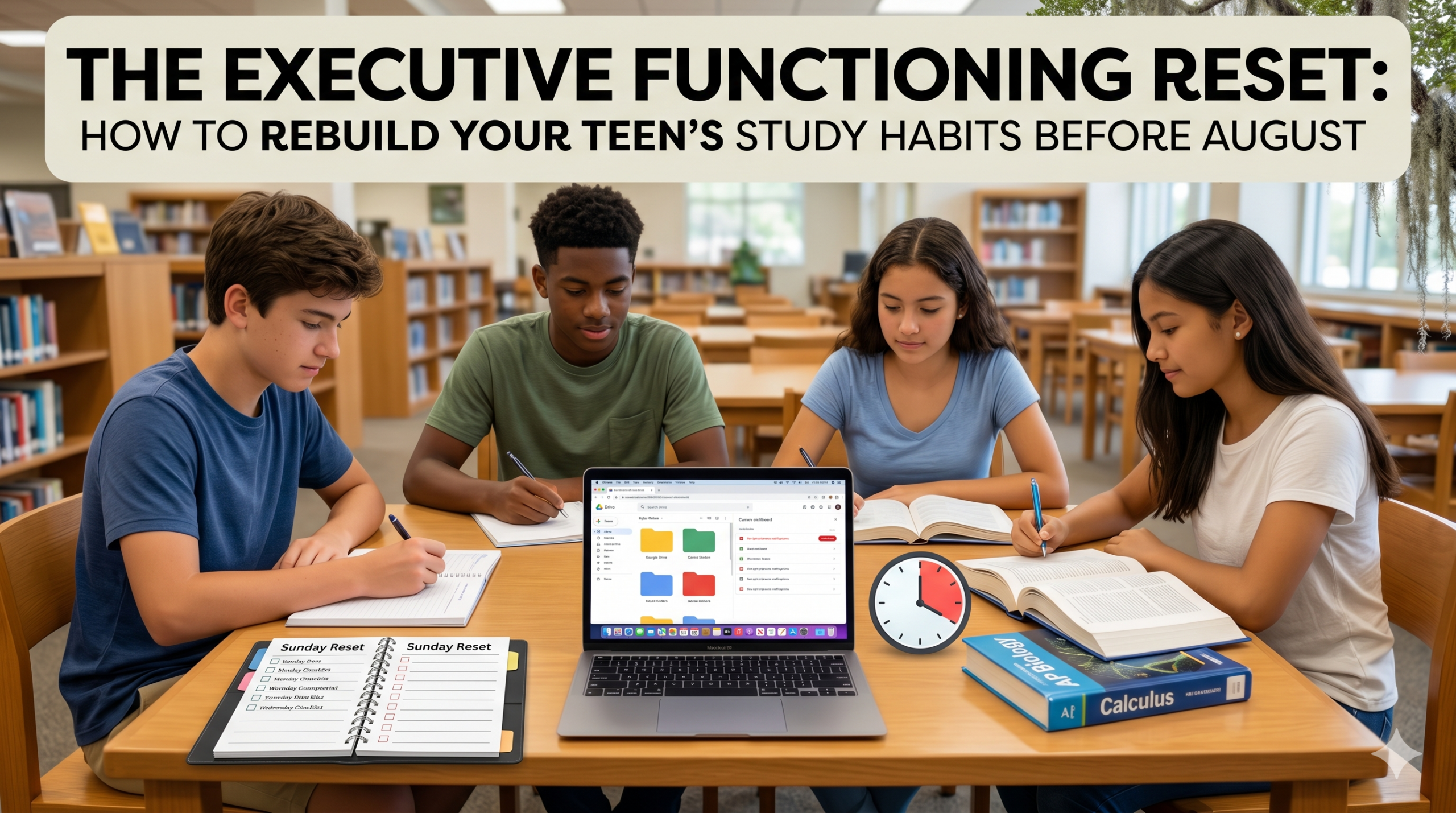
TL;DR: As the spring semester wraps up, many parents are watching their previously high-achieving teenagers burn out, miss deadlines, and suffer entirely avoidable GPA drops. The root cause is rarely the difficulty of the curriculum; it is a total collapse of their organizational systems. Summer is the only distraction-free window to overhaul these habits. By executing a digital declutter, implementing a “Sunday Reset” routine, and introducing a neutral collegiate mentor to act as an organizational coach, you can rebuild your teenager’s executive functioning. This ensures they walk into August fully prepared for the immense academic pressure of the upcoming school year.
Table of Contents
1. The Spring Semester Autopsy: Why Smart Kids Crash
We are sitting right at the finish line of the academic year, and the burnout is palpable. Across Florida, parents are logging into digital school portals in mid-May and experiencing a familiar shock: a straight-A student suddenly has a C in AP Chemistry, or a usually responsible sophomore has 14 missing assignments in their history class.
The immediate parent reaction is usually to assume the teenager has become lazy or that the teacher is being unreasonable. However, after auditing thousands of students, the reality is almost always different. Your teenager did not suddenly lose their intelligence in March. What failed them was not their brain; it was their organizational framework, scientifically defined as executive functioning.
Executive functioning is the invisible engine of academic success. It is the cognitive ability to plan ahead, organize materials, sustain focus, and manage time. When a student transitions into upper-level AP tracks or rigorous magnet programs, sheer willpower and intelligence are no longer enough to keep up with the volume of work. When the workload dramatically increases, a teenager without rigid organizational systems will inevitably crash.
Waiting until August to address these missing skills guarantees a repeat of the spring semester panic. Summer is the only viable window to rebuild these core executive functioning skills because the immense, daily pressure of imminent deadlines has been temporarily removed.
Note to Parents: Not sure if your student is struggling with the actual subject material or if their organizational systems are simply breaking down? The difference dictates your entire summer strategy. If their backpack is a black hole of crumpled papers and their digital portals are filled with red “Late” badges, executive dysfunction is the culprit.
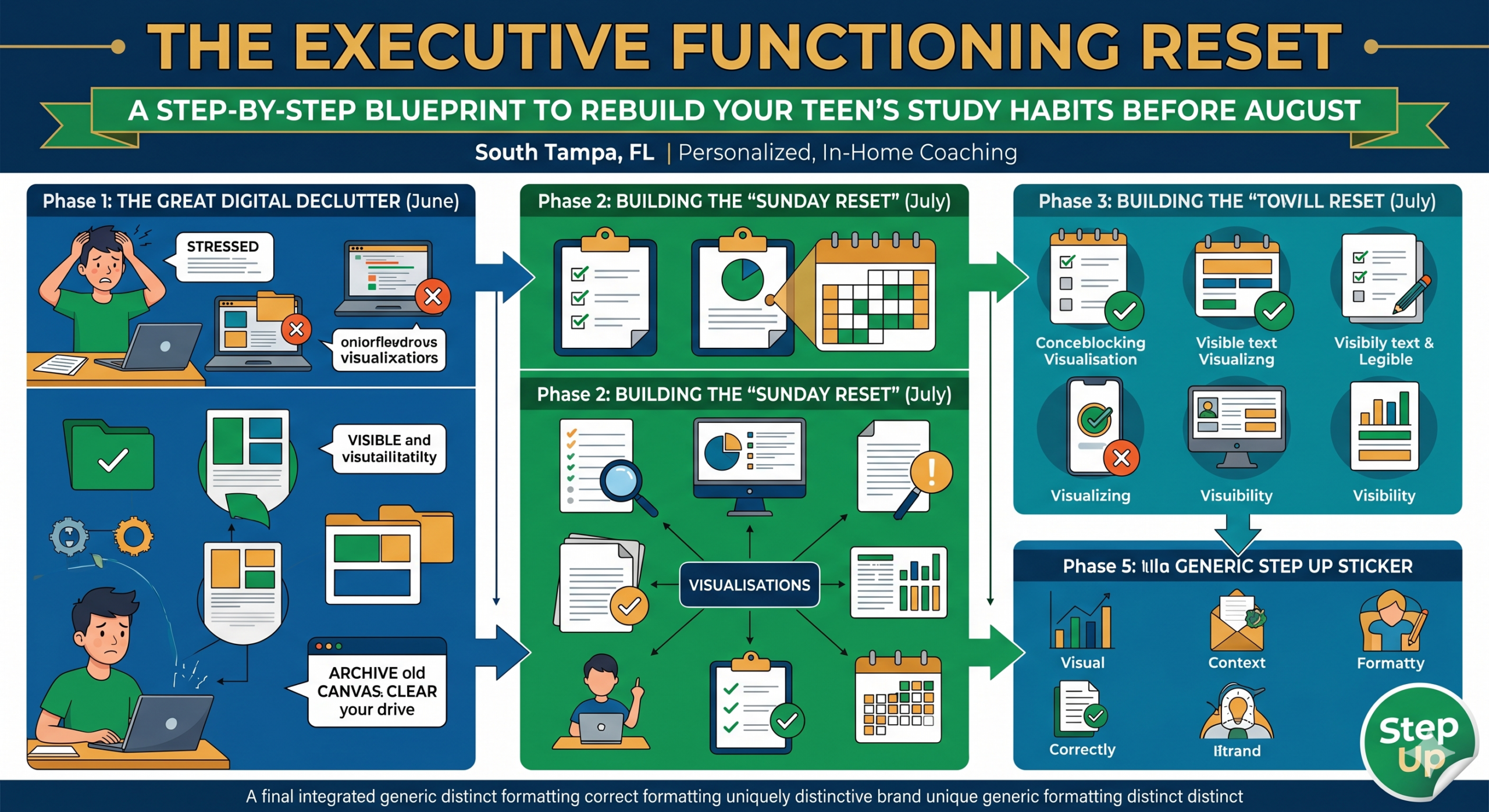
2. Phase 1: The Great Digital Declutter (June)
You cannot build a highly efficient, brand-new organizational system on top of a completely chaotic foundation. Today’s high schoolers are digital hoarders. Their laptops and tablets are graveyards of untitled documents, thousands of unread school emails, and chaotic browser tabs. The first step of the summer reset must be a ruthless digital declutter.
Step 1: The Canvas Archive The Canvas learning management system (or whichever portal your district uses) is the central nervous system of your teenager’s academic life. Over the school year, old modules, defunct discussion boards, and outdated announcements pile up, creating severe visual clutter. Have your student go through their dashboard and archive every single past class. They should only see a clean, blank slate waiting for the fall semester’s courses to populate.
Step 2: The Google Drive Overhaul If you open a high schooler’s Google Workspace Drive, you will typically find fifty documents named “Untitled Doc 1” or “History Draft final final.” This makes studying for cumulative exams impossible because they literally cannot find their own notes. During June, sit down and help them create a master folder for the upcoming academic year (e.g., “Junior Year 2026-2027”). Inside that master folder, create color-coded sub-folders for every single class on their upcoming schedule.
Step 3: The Inbox Purge Teenagers notoriously ignore their school-issued email accounts, missing crucial communication from teachers regarding extra credit or syllabus changes. Spend one afternoon clearing the inbox to zero. Unsubscribe from the dozens of automated Google Classroom notifications that clog the feed, leaving only direct, actionable emails from teachers and administrators.
3. Phase 2: Building the “Sunday Reset” Routine (July)
Motivation is an absolute myth in high school. You cannot rely on a 16-year-old to simply “feel motivated” to study AP Calculus on a Tuesday night after an exhausting two-hour sports practice. Motivation fluctuates; routine is everything.
During July, the goal is to introduce and establish the “Sunday Reset.” This is a mandatory, 20-minute weekly planning session that acts as the strategic command center for the upcoming week. It prevents the nightly panic of discovering a major project is due the next morning.
The Anatomy of a Sunday Reset:
-
The Portal Audit: The student logs into all digital platforms and writes down every single hard deadline for the upcoming Monday through Friday.
-
The Time-Block: Using a physical planner or a digital calendar, the student blocks out their non-negotiable commitments first: school hours, sports practices, club meetings, and family dinners.
-
The Study Slot Allocation: Once the fixed schedule is visible, the student assigns specific study tasks to the remaining open windows. Instead of writing “Study for Chemistry,” they write, “Tuesday, 7:00 PM – 7:45 PM: Complete Chemistry Chapter 4 practice problems.”
By making the Sunday Reset a non-negotiable family habit over the summer, the student builds the muscle memory required to execute it independently when the high school academic demands skyrocket in August.
4. Phase 3: The Low-Stakes Practice Run (Late July)
You cannot introduce a brand-new organizational routine on the first day of the fall semester. The sheer shock of the new schedule will cause the student to revert to their old, chaotic habits immediately. They need to practice their new executive functioning systems in a controlled environment where the academic stakes are essentially zero.
Late July and early August offer the perfect window for a “Practice Run.” You can use several low-stakes summer tasks to test-drive the Sunday Reset:
-
AP Summer Reading: Instead of letting them cram the entire assigned AP novel in the three days before school starts, have them use their Sunday Reset to map out reading two chapters every Tuesday and Thursday evening.
-
Standardized Test Prep: If your student is utilizing summer hours for SAT/ACT test prep, treat it like a core class. Have them schedule their practice modules and vocabulary drills into their weekly calendar.
-
The Pomodoro Technique: Introduce focus-management tools during these summer study sessions. Have them use a free Pomodoro technique timer (25 minutes of intense, phone-free focus followed by a 5-minute break) while completing their summer assignments to rebuild their attention span before sitting in a classroom.
5. The Proof: From Canvas Chaos to the Dean’s List
The theory of executive functioning sounds great, but parents need to know it translates to actual GPA preservation.
Consider a classic profile: a highly intelligent sophomore who finished the fall semester with a 3.8 GPA, only to crash to a 2.9 by the end of May. When our mentors audited his systems, we found 42 missing or late assignments hiding in his digital portals, a backpack full of crumpled study guides, and zero time-management skills. He wasn’t failing because he didn’t understand the material; he was failing because he was academically disorganized.
Over the summer, his parents brought in The Tutoring Company to facilitate an executive functioning reset. For six weeks, his collegiate mentor walked him through the exact digital declutter and Sunday Reset blueprint outlined above. They used his summer SAT prep to practice time-blocking and digital folder organization.
When junior year began—notoriously the hardest academic year—he didn’t just survive; he thrived. Because his organizational systems were fully automated, he could dedicate 100% of his cognitive energy to actually learning AP Chemistry and Pre-Calculus, rather than panicking about missing due dates. He maintained a 3.9 unweighted GPA through the fall, entirely because his underlying systems held the line.
6. The Teenage Dynamic: Why Parents Can’t Be the Coach
As a parent, reading this roadmap is empowering. The steps are logical, actionable, and clearly effective. However, the most critical piece of advice we can give you is this: You cannot be the one to execute this with your teenager.
We have to acknowledge the teenage dynamic. High schoolers are biologically wired to seek independence and naturally resist advice from their parents. If you sit them down on a Sunday afternoon and attempt to force them to color-code their Google Drive or time-block their calendar, it will instantly be perceived as nagging, micromanaging, and hovering. It will ignite an argument at the kitchen table and ruin your weekend.
This is exactly why collegiate mentorship is the ultimate lifehack for parents. A sharp, successful mentor in their early twenties does not feel like an authority figure to a stressed 16-year-old; they feel like a highly relatable role model. A high school junior will happily accept a Sunday planning routine, essay feedback, and time-management strategies from a collegiate mentor that they would immediately and aggressively reject from Mom or Dad.
Bring in a professional to change the temperature of the house. Step out of the exhausting role of the “Homework Police” and go back to simply being a supportive, encouraging parent while the experts rebuild their academic foundation.
7. Frequently Asked Questions (FAQ)
Why does executive functioning collapse so dramatically in high school? In middle school, teachers act as the executive functioning system for the student. They check planners, provide constant reminders, and offer extreme leniency on late work. In high school—especially in AP or IB tracks—that safety net is entirely removed. The student is suddenly expected to manage long-term projects and multiple collegiate-level syllabi independently, which causes a rapid systems collapse if they haven’t been taught how to self-manage.
How does rebuilding study habits affect scholarship opportunities? The financial stakes of high school are massive. In the state of Florida, preserving a high GPA is the only way to secure the top tier of the Florida Bright Futures Scholarship, which covers 100% of university tuition. A single disastrous semester caused by poor organization can drop a GPA below the rigid scholarship threshold, costing families tens of thousands of dollars. Executive functioning is essentially financial protection.
Can a tutor really change a teenager’s lazy habits? We do not believe “laziness” is a permanent trait; it is almost always a symptom of being overwhelmed. When a student doesn’t know where to start, they freeze, which looks like laziness to an adult. By breaking massive academic workloads down into bite-sized, highly actionable daily steps, our mentors remove the overwhelming friction, replacing procrastination with execution.
How long does it take to establish the Sunday Reset routine? Behavioral psychology dictates that it takes roughly four to six weeks of consistent, guided repetition to turn a forced action into an automatic habit. This is why attempting to start the Sunday Reset in the middle of September always fails—the student is already too stressed. Using the six weeks of summer provides the perfect, low-stress incubation period.
How do we start the summer mentorship process? The process is entirely frictionless. You simply visit our Contact Us page and fill out the Student Profiler. This allows our leadership team to understand your teenager’s exact pain points, personality type, and academic goals. From there, we hand-select the perfect collegiate mentor to guide them through the summer reset right at your dining room table.