
1. The Gainesville College Admissions Landscape
Living in Gainesville places families right next to the state’s flagship research university: the University of Florida (UF). In homes across Haile Plantation, Town of Tioga, Oakmont, Longleaf, Duckpond, and Millhopper, preparing for higher education is a central topic for parents and students alike. Parents working as physicians at UF Health, researchers on campus, and local entrepreneurs know how competitive collegiate admissions have become across Florida.
Because students see UF’s Century Tower every day, high schoolers throughout Alachua County often focus their college dreams right at home. However, securing admission to UF—or leveraging the state’s generous scholarship programs—requires high-level planning. Standardized testing remains mandatory across the State University System of Florida (SUS). While many universities nationally shifted toward test-optional admissions, Florida public universities require official SAT, ACT, or Classic Learning Test (CLT) scores.
For Gainesville families, testing serves two critical functions: qualifying for the Florida Bright Futures Scholarship Program, which covers up to 100% of undergraduate tuition, and meeting competitive freshman admissions criteria. Transitioning to the College Board’s adaptive digital testing format means old test-taking methods are obsolete. Success requires a data-backed testing plan, targeted Digital SAT and ACT test prep with accommodations, and structured executive function and study skills coaching to keep test prep on schedule.
2. Alachua County Neighborhoods & Feeder Schools We Serve
The Tutoring Company provides 1-on-1 in-home and live virtual SAT and ACT instruction tailored to the specific testing schedules and curriculum tracks of Gainesville schools:
Southwest Gainesville: Haile Plantation & Oakmont
Serving Haile Plantation, Oakmont, Longleaf, and the SW 24th Avenue corridor. Supporting students attending Lawton M. Chiles Elementary and Kanapaha Middle as they transition into advanced AP and STEM programs at F.W. Buchholz High School.
West Gainesville & Tioga: Jonesville & Town of Tioga
Serving Town of Tioga, Jonesville, and Arbor Greens along Newberry Road. Supporting students from Meadowbrook Elementary, Hidden Oak Elementary, and Fort Clarke Middle targeting early PSAT and SAT readiness.
Northwest Gainesville: Millhopper & Suburban Heights
Serving Millhopper, San Felasco, Suburban Heights, and Blues Creek. Guiding students at Talbot Elementary and Westwood Middle who are preparing for the Cambridge AICE curriculum at Gainesville High School.
Historic East & Central: Duckpond & Midtown
Serving Duckpond, University Park, and Midtown. Guiding students attending P.K. Yonge Developmental Research School, Howard W. Bishop Middle, Oak Hall School, Saint Francis Catholic Academy, and Eastside High School’s International Baccalaureate (IB) Programme.
3. Florida Bright Futures Scholarship Tiers: FAS vs. FMS
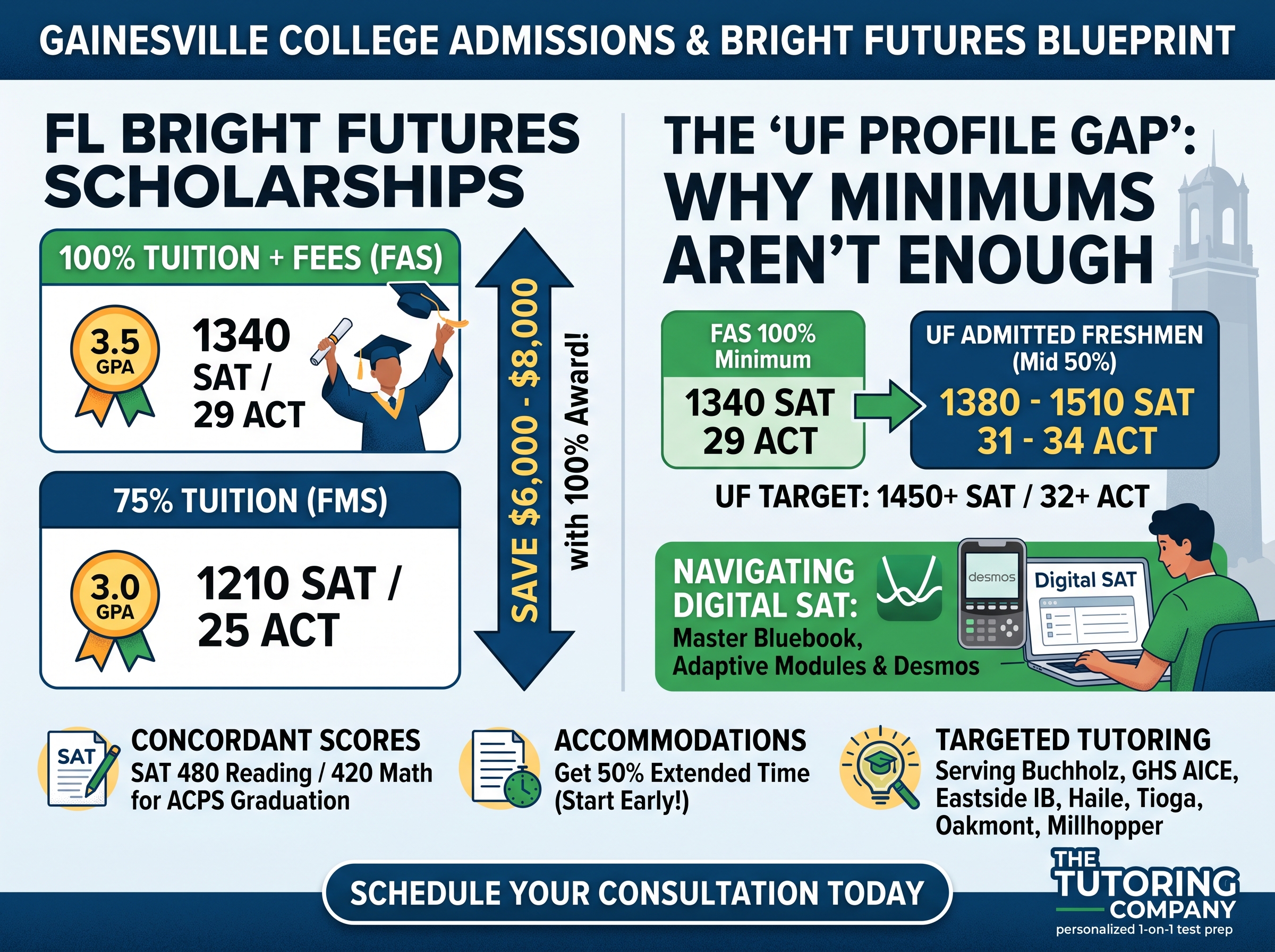
The Florida Bright Futures Scholarship Program is funded by the Florida Lottery to reward high-achieving high school graduates. The state guidelines outlined in the Florida Department of Education Bright Futures Student Handbook outline two primary scholarship tiers:
| Scholarship Tier | Tuition Coverage | Weighted GPA | SAT Score Minimum | ACT Score Minimum | Service Hours |
|---|---|---|---|---|---|
| Florida Academic Scholars (FAS) | 100% Tuition + Applicable College Fees | 3.50 Weighted | 1340 | 29 | 100 Volunteer (or 100 Paid Work) |
| Florida Medallion Scholars (FMS) | 75% Tuition (at 4-Year Institutions) | 3.00 Weighted | 1210 | 25 | 75 Volunteer (or 100 Paid Work) |
The Financial Value: Over four years at the University of Florida or Florida State University, moving from the 75% Medallion award to the 100% Academic Scholars award saves roughly $6,000 to $8,000 in tuition and fees. Increasing an SAT score by 130 points can deliver an exceptional return on investment for families.
Students can combine their highest section scores across multiple test dates through superscoring. The Florida Office of Student Financial Assistance (OSFA) accepts test scores through June 30th of a student’s high school graduation year, giving students time to reach their targets.
4. The UF Profile Gap: Why Bright Futures Minimums Aren’t Enough
A frequent misconception among Gainesville high schoolers is assuming that earning the 100% Bright Futures FAS score (1340 SAT or 29 ACT) ensures admission into the University of Florida. In reality, meeting state scholarship minimums is only the baseline.
  ┌────────────────────────────────────────────────────────────────────────┐
  │                 THE GAINESVILLE ADMISSIONS GAP: 2026 BENCHMARKS        │
  └────────────────────────────────────────────────────────────────────────┘

    FLORIDA BRIGHT FUTURES FAS (100% TUITION)
    ├─ SAT Minimum: 1340
    └─ ACT Minimum: 29

    UNIVERSITY OF FLORIDA (UF) ADMITTED FRESHMAN MIDDLE 50%
    ├─ SAT Range:   1380 – 1510
    ├─ ACT Range:   31 – 34
    └─ Weighted GPA: 4.4 – 4.6
According to the official University of Florida Admissions Guide, the middle 50% of admitted freshmen score well above the Bright Futures requirement. Half of admitted students score between 1380 and 1510 on the SAT, and 25% score above 1510.
For students at Buchholz, Eastside IB, GHS, or Oak Hall aiming for UF, the real target is 1450+ on the SAT or 32+ on the ACT. Hitting those scores positions students well for UF while comfortably securing the 100% Bright Futures award.
5. Navigating the Multistage Adaptive Digital SAT & Desmos
The College Board’s Digital SAT is an adaptive, computer-based exam that differs significantly from previous paper-and-pencil formats:
       ┌─────────────────────────────────────────────────────────────┐
       │             MULTISTAGE ADAPTIVE DIGITAL SAT ARCHITECTURE    │
       └─────────────────────────────────────────────────────────────┘
                                      │
         ┌────────────────────────────┴────────────────────────────┐
         ▼                                                         ▼
  ┌──────────────┐                                          ┌──────────────┐
  │ MODULE 1     │ (Baseline Mix: Easy, Med, Hard)          │ MODULE 1     │
  │ READING/WRIT │                                          │ MATH         │
  └──────┬───────┘                                          └──────┬───────┘
         │                                                         │
   PERFORMANCE ON MODULE 1 DETERMINES ROUTING:                     │
         ├─────────────────────────────┐                           │
         ▼                             ▼                           ▼
  ┌──────────────┐              ┌──────────────┐            ROUTING DECIDED
  │ MODULE 2     │              │ MODULE 2     │            BY MODULE 1
  │ (UPPER TIER) │              │ (LOWER TIER) │            MATH ACCURACY
  ├──────────────┤              ├──────────────┤
  │• Max score:  │              │• Score capped│
  │  800         │              │  below ~600  │
  └──────────────┘              └──────────────┘
The Critical Module 1 Gateway
The Digital SAT features two sections: Reading and Writing, and Math. Each section contains two timed modules. Module 1 contains a mix of easy, medium, and difficult questions. How a student performs on Module 1 determines whether they route to the upper-tier or lower-tier version of Module 2.
If a student makes unforced errors on early questions and routes to the easier Module 2, their section score is mathematically capped—often making a 1340+ Bright Futures score mathematically impossible on that test date. Our tutors train students to approach Module 1 with care to unlock the higher-scoring module.
Built-In Desmos Calculator Mastery
The Digital SAT features an integrated version of the Desmos Graphing Calculator directly inside the testing app. On the math section, students who know how to use Desmos can solve complex systems of equations, regressions, and functions quickly. Our math tutoring in Gainesville teaches students how to solve problems using both traditional formulas and Desmos methods aligned with the Florida B.E.S.T. mathematics standards.
6. Concordant Scores: Protecting High School Graduation in ACPS
Beyond scholarship qualification, standardized testing serves as an important graduation safety net. Under Florida Department of Education graduation requirements, every student must pass two primary assessments to earn a standard high school diploma:
- The Grade 10 Florida Assessment of Student Thinking (FAST) ELA Reading Assessment (Level 3 or higher).
- The Florida B.E.S.T. Algebra 1 End-of-Course (EOC) Exam (Level 3 or higher).
Students who miss passing scores on state assessments can satisfy graduation requirements through alternative concordant scores outlined in the FDOE Graduation Assessment Requirements Framework:
| Graduation Requirement | State Assessment | SAT Concordant Score | ACT Concordant Score | PSAT/NMSQT Concordant |
|---|---|---|---|---|
| Grade 10 Reading / ELA | FAST Grade 10 ELA (Level 3) | 480 (EBRW) | 18 (Average of English/Reading) | N/A |
| Algebra 1 Graduation Req | Algebra 1 B.E.S.T. EOC (Level 3) | 420 (Math Section) | 16 (Math Section) | 430 (Math Section) |
For Alachua County high schoolers balancing challenging workloads, preparing for the SAT or ACT doubles as preparation for both concordant graduation scores and college scholarship cutoffs. Detailed testing options are outlined on the Alachua County Public Schools ACT, SAT, and CLT Assessment Guidance page.
7. School-Specific Timelines: Buchholz, Eastside IB, & GHS AICE
Different high schools across Alachua County feature unique academic tracks that influence test preparation timelines:
F.W. Buchholz High School: AP and Accelerated STEM
Buchholz students often take accelerated math sequences early, with many completing Algebra 2 Honors by 9th or 10th grade. Because their math foundations are strong, taking the SAT early in junior year (August, October, or November) allows students to earn their target scores before spring AP exams begin. Testing policies and schedules can be tracked through F.W. Buchholz High School General Testing Information.
Eastside High School: International Baccalaureate (IB) Programme
Eastside IB students carry demanding coursework during 11th and 12th grade, including Internal Assessments (IAs), Theory of Knowledge (TOK) essays, and the Extended Essay. Waiting until spring of junior year to start SAT or ACT prep creates unnecessary stress. We recommend Eastside students establish baseline test scores by December of junior year.
Gainesville High School: Cambridge AICE Program
GHS students working toward the Cambridge AICE Diploma can qualify for 100% Bright Futures FAS tuition without meeting the standard SAT/ACT score minimums, provided they complete the AICE curriculum and earn 100 service hours. However, Florida public universities like UF and FSU still require competitive SAT/ACT scores for general admission. Earning the AICE diploma does not eliminate the need for strong test prep.
8. Securing 50% Extended Time on the SAT & ACT
For students with documented learning differences, ADHD, or anxiety disorders who use a Section 504 Plan or IEP at school, testing accommodations can make a substantial difference. Having 50% extended time provides the room needed to pace through reading passages and calculate multi-step math problems without panic.
However, school-approved accommodations do not transfer automatically to the College Board or ACT. Families must submit a formal accommodations request with supporting documentation at least seven weeks before their scheduled test date. We recommend starting this process in 10th grade to ensure approvals are in place ahead of time.
9. The Tutoring Company Test Prep Methodology
Generic group test prep programs often focus on memorization and generic tricks. The Tutoring Company uses a personalized 1-on-1 model designed to help students maximize their individual score potential:
1. Diagnostic Assessment
We start with an official full-length diagnostic exam to analyze question-level performance, identifying specific gaps in geometry, algebra, grammar rules, or passage timing.
2. Desmos & Digital Tool Training
Students learn how to use the Digital SAT’s built-in Desmos graphing calculator, digital highlighters, and process-of-elimination tools to solve questions efficiently.
3. High-Leverage Score Targeting
We focus prep on the specific areas where points can be gained most reliably—whether that means closing a 50-point gap to hit Bright Futures 1340 or pushing past 1450 for UF admissions.
10. Frequently Asked Questions for Gainesville Families
What SAT or ACT score does my child need for 100% Bright Futures?
To qualify for the 100% Florida Academic Scholars (FAS) award, students must earn a minimum score of 1340 on the SAT or 29 on the ACT. For the 75% Florida Medallion Scholars (FMS) award, the requirement is 1210 on the SAT or 25 on the ACT.
Does a 1340 SAT score guarantee admission to the University of Florida?
No. While 1340 meets the threshold for 100% Bright Futures tuition, UF’s middle 50% admitted freshman range is 1380 to 1510 on the SAT and 31 to 34 on the ACT. Students targeting UF should aim for a 1400+ SAT or 31+ ACT to be academically competitive.
When should my high school student begin test prep in Gainesville?
We recommend taking a diagnostic test during the spring of sophomore year or summer before junior year. This allows students to target the fall SAT/ACT administrations of their junior year, leaving spring and summer test dates available for superscoring without conflicting with AP, IB, or AICE exams.
Can my child use an SAT score to meet Florida graduation requirements?
Yes. Under Florida Department of Education concordant rules, an SAT score of 480 on the Reading and Writing section satisfies the Grade 10 FAST ELA graduation requirement. An SAT Math score of 420 satisfies the Algebra 1 End-of-Course graduation requirement.
11. Start Your Gainesville Test Prep Plan
Whether your goal is securing 100% Bright Futures tuition, building a competitive application for the University of Florida, or locking in concordant graduation scores, targeted 1-on-1 test prep makes all the difference.
The Tutoring Company connects Gainesville families with dedicated mentors who understand the Digital SAT, the ACT, and the local curriculum at Buchholz, Eastside, and Gainesville High.