1. The Tampa Bay College Admissions & Scholarship Climate
Throughout Hillsborough County—from the tree-lined avenues of Palma Ceia, Hyde Park, and Beach Park to master-planned communities in Westchase, Carrollwood, and Tampa Palms—academic achievement is central to family life. Situated alongside the research enterprise of the University of South Florida (USF) and within easy commuting reach of statewide universities, Tampa families place a premium on rigorous coursework, competitive class rank, and selective collegiate admissions.
Because local cohorts are academically ambitious, parents understand that admissions standards across the State University System of Florida (SUS) have risen significantly. While many private universities nationally adopted test-optional admissions policies, Florida public universities strictly mandate official SAT, ACT, or Classic Learning Test (CLT) scores for all undergraduate applicants.
For Tampa families, test preparation serves two critical goals: qualifying for the Florida Bright Futures Scholarship Program, which covers up to 100% of undergraduate tuition, and ensuring an application stands out in competitive applicant pools at UF, FSU, USF, and top out-of-state universities. Navigating the College Board’s adaptive digital exam requires diagnostic planning, targeted Digital SAT and ACT test prep with accommodations, and structured executive function and study skills coaching to keep test prep on schedule.
2. Hillsborough County Neighborhoods & Feeder Schools We Serve
The Tutoring Company provides 1-on-1 private in-home and live virtual SAT and ACT instruction tailored to the academic timelines and curriculum tracks of Hillsborough County schools:
South Tampa: Palma Ceia, Hyde Park, & Beach Park
Serving Palma Ceia, Hyde Park, Beach Park, Culbreath Isles, and Davis Islands. Guiding students from Mabry, Roosevelt, Mitchell, Coleman Middle, and Wilson Middle preparing for honors and AP Capstone workloads at H.B. Plant High School.
Northwest Hillsborough: Westchase & Carrollwood
Serving Westchase (The Bridges, The Fords, West Park Village), Carrollwood, and Cheval. Supporting students attending Westchase Elementary, Davidsen Middle, Farnell Middle, Alonso High School, and Sickles High School.
New Tampa & USF Corridor: Tampa Palms & Hunters Green
Serving Tampa Palms, Hunters Green, and Cory Lake Isles. Supporting students from Benito Middle moving into Freedom High School and regional STEM magnet academies.
Independent & College Preparatory Academies
Serving families throughout Tampa whose students attend selective independent academies—including Jesuit High School, Tampa Catholic High School, Berkeley Preparatory School, and Academy of the Holy Names—as well as the county-wide IB magnet at Robinson High School.
3. Florida Bright Futures Scholarship Tiers: FAS vs. FMS
The Florida Bright Futures Scholarship Program is funded by the Florida Lottery to reward high-achieving high school graduates across the state. Under statutory guidelines published in the Florida Department of Education Bright Futures Student Handbook, students can qualify for two primary scholarship awards:
| Scholarship Tier | Tuition Coverage | Weighted GPA | SAT Score Minimum | ACT Score Minimum | Service Hours |
|---|---|---|---|---|---|
| Florida Academic Scholars (FAS) | 100% Tuition + Applicable College Fees | 3.50 Weighted | 1340 | 29 | 100 Volunteer (or 100 Paid Work) |
| Florida Medallion Scholars (FMS) | 75% Tuition (at 4-Year Institutions) | 3.00 Weighted | 1210 | 25 | 75 Volunteer (or 100 Paid Work) |
The Financial Return: Over four years at Florida public institutions like USF, UF, or FSU, moving from the 75% Medallion tier to the 100% Academic Scholars tier saves roughly $6,000 to $8,000 in tuition and campus fees. Elevating an SAT score by 130 points delivers an immediate, substantial return on investment for families.
Florida permits test superscoring, allowing students to combine their best section scores across different official test administrations. The Florida Office of Student Financial Assistance (OSFA) accepts test scores earned through June 30th of a student’s high school graduation year. Guidance departments across the county provide regular updates, as highlighted on the H.B. Plant High School Guidance & College Planning Portal.
4. The Competitive Admissions Reality: USF, UF, & FSU Medians
A common mistake among Tampa families is assuming that meeting the 100% Bright Futures FAS score (1340 SAT or 29 ACT) guarantees admission to Florida’s most competitive state universities. In reality, state scholarship cutoffs represent baseline qualifying minimums, not competitive medians.
  ┌────────────────────────────────────────────────────────────────────────┐
  │                 THE FLORIDA ADMISSIONS PROFILE COMPARISON              │
  └────────────────────────────────────────────────────────────────────────┘

    FLORIDA BRIGHT FUTURES FAS (100% TUITION QUALIFIER)
    ├─ SAT Minimum: 1340
    └─ ACT Minimum: 29

    UNIVERSITY OF SOUTH FLORIDA (USF) ADMITTED FRESHMAN PROFILE
    ├─ SAT Mid-50%: 1240 – 1370
    └─ ACT Mid-50%: 27 – 31

    UNIVERSITY OF FLORIDA (UF) ADMITTED FRESHMAN PROFILE
    ├─ SAT Mid-50%: 1380 – 1510
    └─ ACT Mid-50%: 31 – 34
According to profile data from the University of South Florida Freshman Admissions Profile, competitive majors—including pre-med, engineering, and cybersecurity—frequently admit students well above general averages. For students at Plant, Robinson IB, Jesuit, or Berkeley Prep targeting UF, FSU, or selective USF Honors pathways, the goal should be 1420+ on the SAT or 31+ on the ACT. Hitting those scores positions students competitively for admissions while securing the 100% Bright Futures award.
5. Navigating the Multistage Adaptive Digital SAT & Desmos
The College Board’s Digital SAT is an adaptive, computer-based exam that differs fundamentally from traditional paper-and-pencil exams:
       ┌─────────────────────────────────────────────────────────────┐
       │             MULTISTAGE ADAPTIVE DIGITAL SAT ARCHITECTURE    │
       └─────────────────────────────────────────────────────────────┘
                                      │
         ┌────────────────────────────┴────────────────────────────┐
         ▼                                                         ▼
  ┌──────────────┐                                          ┌──────────────┐
  │ MODULE 1     │ (Baseline Mix: Easy, Med, Hard)          │ MODULE 1     │
  │ READING/WRIT │                                          │ MATH         │
  └──────┬───────┘                                          └──────┬───────┘
         │                                                         │
   PERFORMANCE ON MODULE 1 DETERMINES ROUTING:                     │
         ├─────────────────────────────┐                           │
         ▼                             ▼                           ▼
  ┌──────────────┐              ┌──────────────┐            ROUTING DECIDED
  │ MODULE 2     │              │ MODULE 2     │            BY MODULE 1
  │ (UPPER TIER) │              │ (LOWER TIER) │            MATH ACCURACY
  ├──────────────┤              ├──────────────┤
  │• Max score:  │              │• Score capped│
  │  800         │              │  below ~600  │
  └──────────────┘              └──────────────┘
The Critical Module 1 Gateway
The exam consists of two sections: Reading and Writing, and Math. Each section contains two timed modules. Module 1 delivers a mix of easy, medium, and difficult questions. A student’s performance on Module 1 determines whether they route to the upper-tier or lower-tier version of Module 2.
If a student makes avoidable errors on early questions and gets routed to the easier Module 2, their section score is mathematically capped—making a 1340+ Bright Futures qualifying score mathematically impossible on that test date. Our tutors train students to approach Module 1 with accuracy to unlock the higher-scoring module.
Built-In Desmos Calculator Mastery
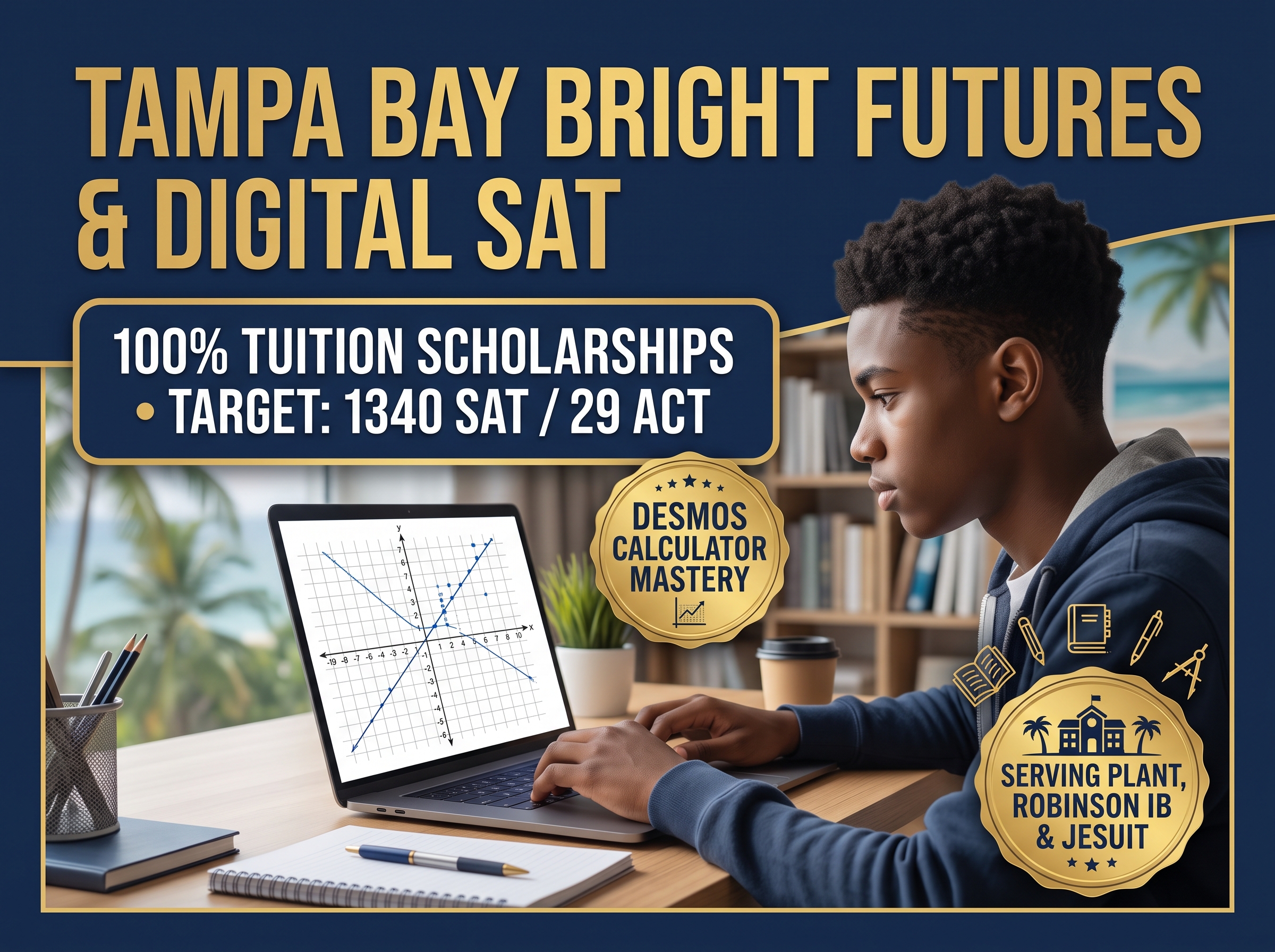
The Digital SAT includes a fully integrated Desmos Graphing Calculator accessible on every math question. Students who master Desmos can solve systems of equations, analyze quadratics, and evaluate complex regressions directly in the graphing interface. Our math tutoring in Tampa trains students to integrate Desmos techniques alongside traditional algebra aligned with the Florida B.E.S.T. mathematics standards.
6. Concordant Scores: Protecting High School Graduation in HCPS
Beyond scholarship qualification, standardized testing serves as an important graduation safety net. Under Florida Department of Education requirements, every public high school student must satisfy two assessment benchmarks to earn a standard diploma:
- The Grade 10 Florida Assessment of Student Thinking (FAST) ELA Reading Assessment (Level 3 or higher).
- The Florida B.E.S.T. Algebra 1 End-of-Course (EOC) Exam (Level 3 or higher).
Students who miss passing thresholds on state tests can satisfy requirements through alternative concordant scores, as documented in the Florida Department of Education Statewide Assessment Graduation Requirements and monitored through the Hillsborough County Public Schools Graduation Requirements Portal:
| Graduation Requirement | State Assessment | SAT Concordant Score | ACT Concordant Score | PSAT/NMSQT Concordant |
|---|---|---|---|---|
| Grade 10 Reading / ELA | FAST Grade 10 ELA (Level 3) | 480 (EBRW) | 18 (Average of English/Reading) | N/A |
| Algebra 1 Graduation Req | Algebra 1 B.E.S.T. EOC (Level 3) | 420 (Math Section) | 16 (Math Section) | 430 (Math Section) |
For Hillsborough County students balancing demanding workloads, preparing for the SAT or ACT doubles as insurance for concordant graduation benchmarks while working toward scholarship cutoffs.
7. School-Specific Timelines: Plant High APs, Robinson IB, & Jesuit
Different high schools across Tampa feature distinct academic tracks that directly influence optimal test preparation schedules:
H.B. Plant High School: AP Capstone & Heavy AP Course Loads
Plant students often complete Algebra 2 Honors by 9th or 10th grade. Because students manage heavy multi-course AP blocks in May (AP Calculus, AP Physics, AP US History), preparing for the SAT early in junior year (August, October, or November) allows students to earn qualifying scores before spring AP review demands take over.
Robinson High School: International Baccalaureate (IB) Programme
Robinson IB students carry demanding coursework during 11th and 12th grade, including Internal Assessments (IAs), Theory of Knowledge (TOK) essays, and the 4,000-word Extended Essay. Waiting until spring of junior year creates unnecessary stress. We recommend Robinson IB students establish baseline test scores by November or December of junior year.
Jesuit High School & Berkeley Preparatory School
Students at Tampa’s independent college-prep schools follow fast-paced curricula that target selective national universities. Taking baseline tests in early junior year leaves winter and spring open for targeted score gains and subject-specific enrichment.
8. Securing 50% Extended Time on the SAT & ACT
For students with documented learning differences, ADHD, or anxiety disorders who use a Section 504 Plan or IEP at school, testing accommodations can make a substantial difference. Having 50% extended time provides the room needed to pace through reading passages and calculate multi-step math problems without panic.
However, school-approved accommodations do not transfer automatically to the College Board or ACT. Families must submit a formal accommodations request with supporting documentation at least seven weeks before their scheduled test date. We recommend starting this process in 10th grade to ensure approvals are in place ahead of time.
9. The Tutoring Company Test Prep Methodology
Generic group test prep programs often focus on memorization and generic tricks. The Tutoring Company uses a personalized 1-on-1 model designed to help students maximize their individual score potential:
1. Diagnostic Assessment
We start with an official full-length diagnostic exam to analyze question-level performance, identifying specific gaps in geometry, algebra, grammar rules, or passage timing.
2. Desmos & Digital Tool Training
Students learn how to use the Digital SAT’s built-in Desmos graphing calculator, digital highlighters, and process-of-elimination tools to solve questions efficiently.
3. High-Leverage Score Targeting
We focus prep on the specific areas where points can be gained most reliably—whether that means closing a 50-point gap to hit Bright Futures 1340 or pushing past 1450 for competitive university programs.
10. Frequently Asked Questions for Tampa Families
What SAT or ACT score does my child need for 100% Bright Futures in Tampa?
To qualify for the 100% Florida Academic Scholars (FAS) award, students must earn a minimum score of 1340 on the SAT or 29 on the ACT, alongside a 3.50 weighted academic GPA and 100 volunteer or paid work hours. For the 75% Florida Medallion Scholars (FMS) award, the requirement is 1210 on the SAT or 25 on the ACT with a 3.00 GPA.
Does completing the Robinson High IB Diploma waive the SAT requirement?
Earning the full IB Diploma along with 100 service hours qualifies a student for the 100% Bright Futures FAS award without meeting the 1340 SAT minimum. However, Florida state universities (including UF, FSU, and USF) still require official SAT or ACT scores for general admissions consideration.
When should my Plant High or Jesuit student begin test preparation?
We recommend taking a full diagnostic test in late sophomore year or the summer before junior year. This allows students to target fall junior-year SAT administrations (August, October, November) and achieve qualifying scores before spring AP exams begin.
Can my child use an SAT score to satisfy graduation requirements in Hillsborough County?
Yes. Under Florida concordant scoring rules, an SAT Reading and Writing score of 480 satisfies the Grade 10 FAST ELA graduation requirement. An SAT Math score of 420 satisfies the Algebra 1 End-of-Course exam graduation requirement.
11. Start Your Tampa Test Prep Plan
Whether your goal is securing 100% Bright Futures tuition, building a competitive profile for Florida universities, or locking in concordant graduation scores, targeted 1-on-1 test prep makes all the difference.
The Tutoring Company connects South Tampa and Westchase families with dedicated mentors who understand the Digital SAT, the ACT, and the local curriculum at Plant, Robinson, and Jesuit.