
Gamify Learning: 4 Fun and Engaging Ways to Boost Student Enthusiasm
The groans are familiar. The glazed-over eyes. The subtle slump in shoulders when a new unit is announced. Keeping students truly engaged and motivated, especially beyond traditional textbook methods, is a perpetual challenge for educators and parents alike. But what if learning felt less like a chore and more like a captivating quest? What if students couldn’t wait to dive into their next lesson?
This is the promise of gamification: taking the compelling psychology that makes video games so addictive and channeling it into the learning process. It’s about applying game design elements and principles to non-game contexts. By tapping into natural human motivators like the desire for achievement, friendly competition, meaningful collaboration, and immediate feedback, gamification transforms mundane study into an exciting adventure. Imagine a classroom, or even a home study session, where students are genuinely enthusiastic about mastering new concepts. This article will explore four fun and engaging ways to gamify learning, transforming the academic experience for students everywhere.
The Core Principles of Gamification for Learning
Gamification is far more nuanced than simply slapping points onto assignments or awarding generic badges. True gamification delves into the psychology of engagement, understanding what drives human behavior in playful environments and applying those mechanisms to education.
At its heart, effective gamification for learning uses several key elements:
- Goals & Challenges: Clear, attainable objectives that take effort and strategic thinking to overcome. Just like a game has levels, learning can have clear milestones.
- Feedback & Progress: Constant, immediate information on performance and visible signs of advancement. Think of a progress bar filling up or a character leveling up in an RPG.
- Rewards & Recognition: Acknowledgment of achievement, whether it’s a digital badge, points, a place on a leaderboard, or even just public praise. These don’t always have to be tangible prizes; often, recognition itself is a powerful motivator.
- Competition & Collaboration: Opportunities for individual striving against others or working together in teams toward a shared objective. Both can be incredibly powerful drivers.
- Storytelling/Narrative: Weaving the learning content into an overarching story or theme that provides context and meaning, making the journey feel more significant.
It’s important to distinguish between gamification and game-based learning. While game-based learning involves using actual games to teach concepts (like educational apps), gamification takes elements from games and applies them to existing curriculum or activities. It’s about structuring the learning experience like a game, rather than simply playing one. For students who struggle with traditional methods, understanding these principles can be a game-changer, and The Tutoring Company specializes in tailoring approaches that leverage these principles.
- Takeaways:
- Gamification taps into natural human desires for achievement, mastery, and recognition.
- It’s more than just adding points; it’s about structuring learning like a game with clear objectives and feedback.
- Key elements include clear goals, visible progress, meaningful rewards, and opportunities for social interaction.
Method 1: Quest-Based Learning & Progression Systems
One of the most effective ways to gamify learning is to frame curriculum units, topics, or even entire courses as “quests” or “missions.” This transforms the learning journey into a narrative adventure, complete with stages, objectives, and a clear path to mastery.
To implement this, educators can break down learning objectives into sequential “levels” or “stages.” For instance, a history unit on ancient civilizations could be a “Journey Through Time,” with each civilization representing a new level. Mastering the Roman Empire unlocks the “Renaissance Quest.” Each level has specific tasks (reading, research, projects, quizzes) that, once completed, allow the student to “level up.”
Visualizing advancement is key. Use digital progress bars, interactive maps that reveal new territories as content is mastered, or even simple checklists where students can physically mark their progression. This provides a clear path forward and reduces feelings of being overwhelmed by the entire course load. Students get a sense of accomplishment with each step, just like completing a mission in a video game. This approach can be particularly beneficial for developing strong study habits, as students are motivated to complete each “level.” When students hit a difficult “boss battle” in their quests, personalized tutoring services from The Tutoring Company can provide the strategic help needed to advance.
- Takeaways:
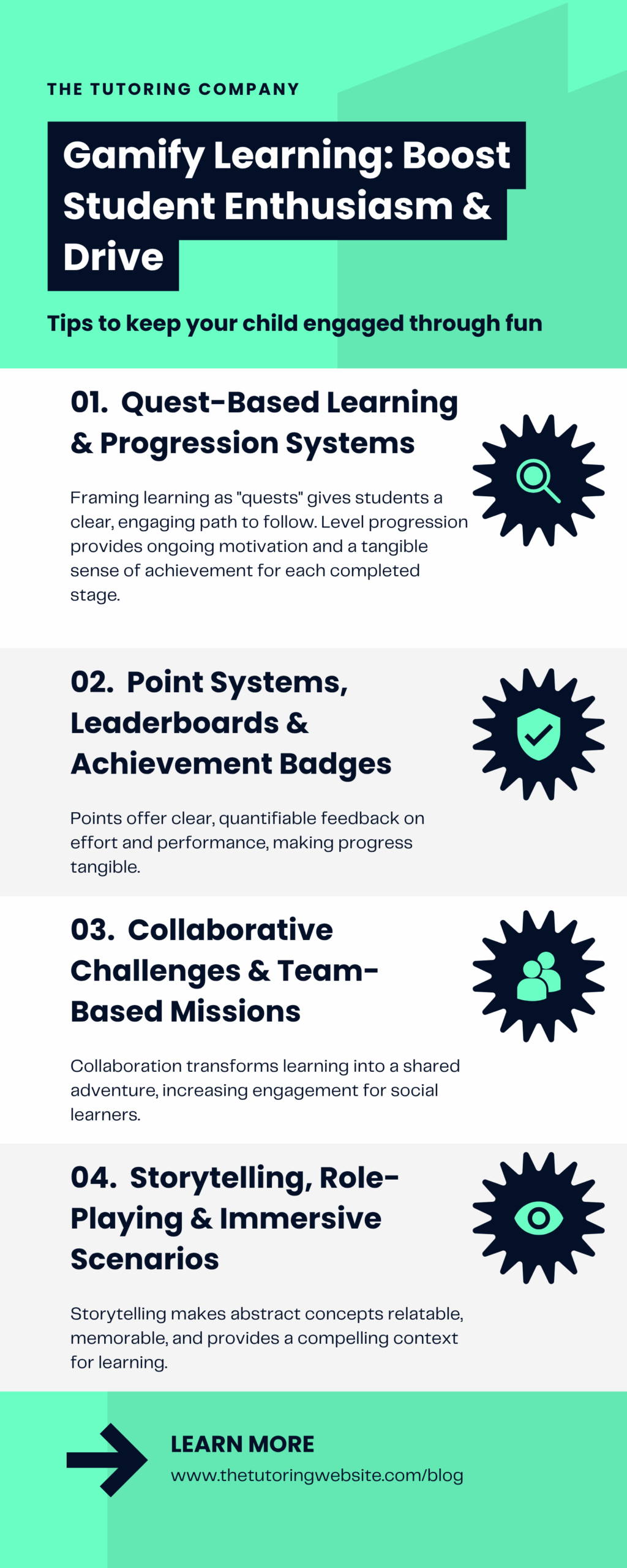
- Framing learning as “quests” gives students a clear, engaging path to follow.
- Level progression provides ongoing motivation and a tangible sense of achievement for each completed stage.
- Visualizing progress helps students understand how far they’ve come and what their next steps are.
Method 2: Point Systems, Leaderboards & Achievement Badges
For many students, the desire for recognition and the thrill of friendly competition are powerful motivators. Gamification uses these by introducing point systems, leaderboards, and achievement badges to quantify effort and celebrate milestones.
Assign points for completing tasks, demonstrating understanding, participating actively in discussions, or even for going above and beyond the basic requirements. For example, a correct answer in a pop quiz could earn 10 points, leading a class discussion might earn 50 points, and submitting an optional enrichment assignment could yield 100 points.
Leaderboards, whether public (if appropriate for the group dynamic) or anonymous (ranking by initials), can foster healthy competition and encourage students to push themselves. The key is to emphasize improvement and effort, not just raw scores. Alongside points, digital badges can be awarded for specific skills learned, challenges overcome, or participation in certain activities. Imagine a “Master Mathemagician” badge for excelling in algebra, or a “Research Reconnaissance” badge for demonstrating strong information-gathering skills. These provide visible recognition that can be proudly displayed, acting as digital trophies of academic prowess. This aligns with principles of personalized learning, as students can pursue badges that highlight their individual strengths. The Tutoring Company encourages students to earn their “mastery badges” through consistent effort and targeted support.
- Takeaways:
- Points offer clear, quantifiable feedback on effort and performance, making progress tangible.
- Leaderboards can motivate through friendly competition (use thoughtfully).
- Badges provide visible recognition for specific skills and achievements, fostering a sense of mastery and accomplishment.
Method 3: Collaborative Challenges & Team-Based Missions
While individual achievement is important, many games emphasize teamwork and collaboration. Applying this to learning can significantly boost engagement, especially for social learners, and develop crucial real-world skills.
Group students into “teams,” “clans,” or “guilds” that work together towards shared academic objectives. Assign group projects as collaborative “missions” where the success of the team depends on the contribution of each member. For instance, a science class might have teams tasked with “designing a sustainable city” (a team mission) that requires research, critical thinking, and collective problem-solving.
Introduce team-based challenges that require diverse skills, encouraging students to leverage each other’s strengths. This might involve a “build a working model” challenge in a physics class, or a “debate tournament” in a civics class where teams prepare arguments together. The emphasis is on peer teaching, mutual support, and collective problem-solving. This approach not only makes learning more dynamic but also helps students develop essential communication and teamwork skills that are vital beyond the classroom. The Tutoring Company also offers small group tutoring, fostering a collaborative environment for learning.
- Takeaways:
- Collaboration transforms learning into a shared adventure, increasing engagement for social learners.
- Team-based missions encourage students to leverage diverse skill sets and support each other.
- Social interaction within a game-like structure can significantly boost communication and problem-solving abilities.
Method 4: Storytelling, Role-Playing & Immersive Scenarios
The most captivating games draw players into rich worlds and compelling narratives. By embedding learning within a compelling story or a simulated real-world scenario, educators can make abstract concepts relatable and deeply memorable.
Create an overarching narrative around the curriculum. For example, a unit on environmental science could frame students as “eco-warriors tasked with saving a virtual planet” by learning about specific ecosystems and conservation efforts. History lessons could become “archaeological digs” where students uncover facts and piece together events.
Assign roles to students that require them to apply learned concepts in a simulated context. A civics class might become a “Mock City Council Meeting” where students adopt roles as mayor, council members, or concerned citizens, tasked with solving a realistic community issue using principles they’ve learned. Use interactive simulations, virtual field trips, or even augmented reality tools to immerse students directly into the subject matter, making the learning experience feel tangible and immediate. This approach encourages active learning strategies by putting students in the driver’s seat of their education. The Tutoring Company encourages students to engage deeply with subjects, turning every lesson into an immersive adventure.
- Takeaways:
- Storytelling makes abstract concepts relatable, memorable, and provides a compelling context for learning.
- Role-playing encourages active application of knowledge and critical thinking in a simulated environment.
- Immersive scenarios deepen understanding, enhance engagement, and make learning feel more relevant and immediate.
Beyond the Game: Fostering Lifelong Learners
Gamifying learning is more than just making education “fun” – it’s about strategically designing the learning experience to tap into powerful psychological motivators. By implementing quest-based progression, point systems with badges, collaborative challenges, and immersive storytelling, educators can transform passive consumption of information into an active, engaging, and genuinely exciting journey.
The ultimate goal isn’t just to make students play games; it’s to cultivate intrinsic motivation, foster a genuine love for discovery, and equip students with a mindset that views challenges as opportunities for growth and mastery. We at The Tutoring Company believe that every student has the potential for enthusiasm. By experimenting with these methods and adapting them to individual needs, we can empower students to take ownership of their learning and truly thrive. After all, learning is the greatest adventure, and gamification is a powerful map to unlock its excitement.
Helpful Resources for Your Academic Journey:
- Understanding Intrinsic Motivation in Education: Explore the science behind why we do what we do. https://www.verywellmind.com/what-is-intrinsic-motivation-2795385
- Practical Gamification Strategies for the Classroom: A comprehensive guide for educators. https://www.edutopia.org/blog/gamification-in-education-resources
- Tools for Interactive Learning: Discover platforms that support gamified education. https://www.classcraft.com/