
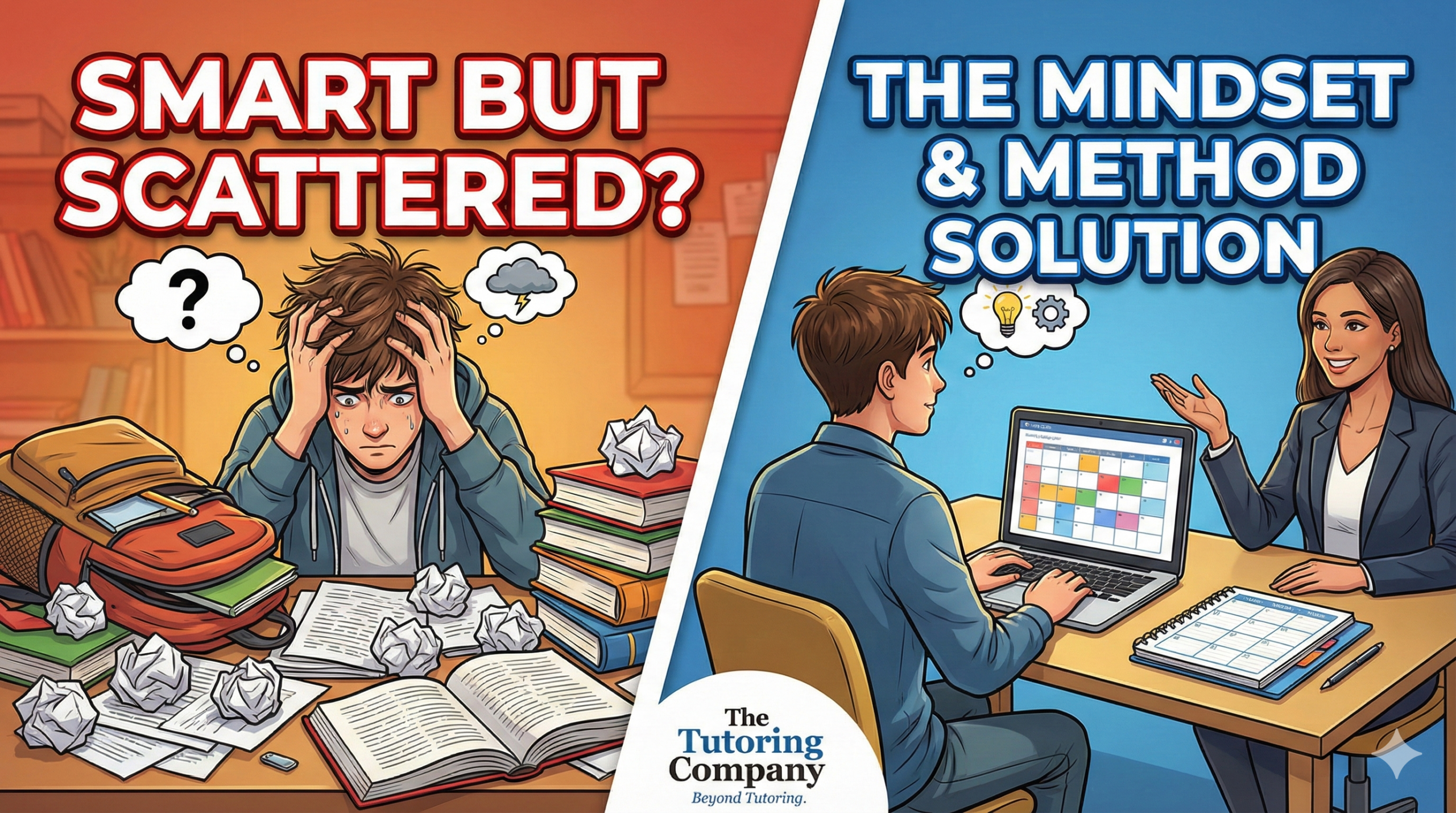
The Mindset & Method Revolution: Why Your Student Needs More Than Just “Tutoring”
The “Smart but Stuck” Paradox
It is the most frustrating mystery in modern parenting. You look at your child and see a bright, articulate, capable human being. They can debate complex topics at the dinner table, memorize intricate video game mechanics, and test in the 90th percentile for intelligence.
But look at their online grade portal, and it tells a different story.
-
Missing Assignments: A sea of zeros for work they swear they finished.
-
Test Anxiety: “Blanking out” on exams they studied for.
-
The Backpack Black Hole: Crumpled worksheets, lost permission slips, and chaos.
You ask them, “Do you have homework?”
They reply, “I did it already.” (Spoiler: They didn’t).
If this sounds familiar, you are not alone. And more importantly: Your child is not lazy.
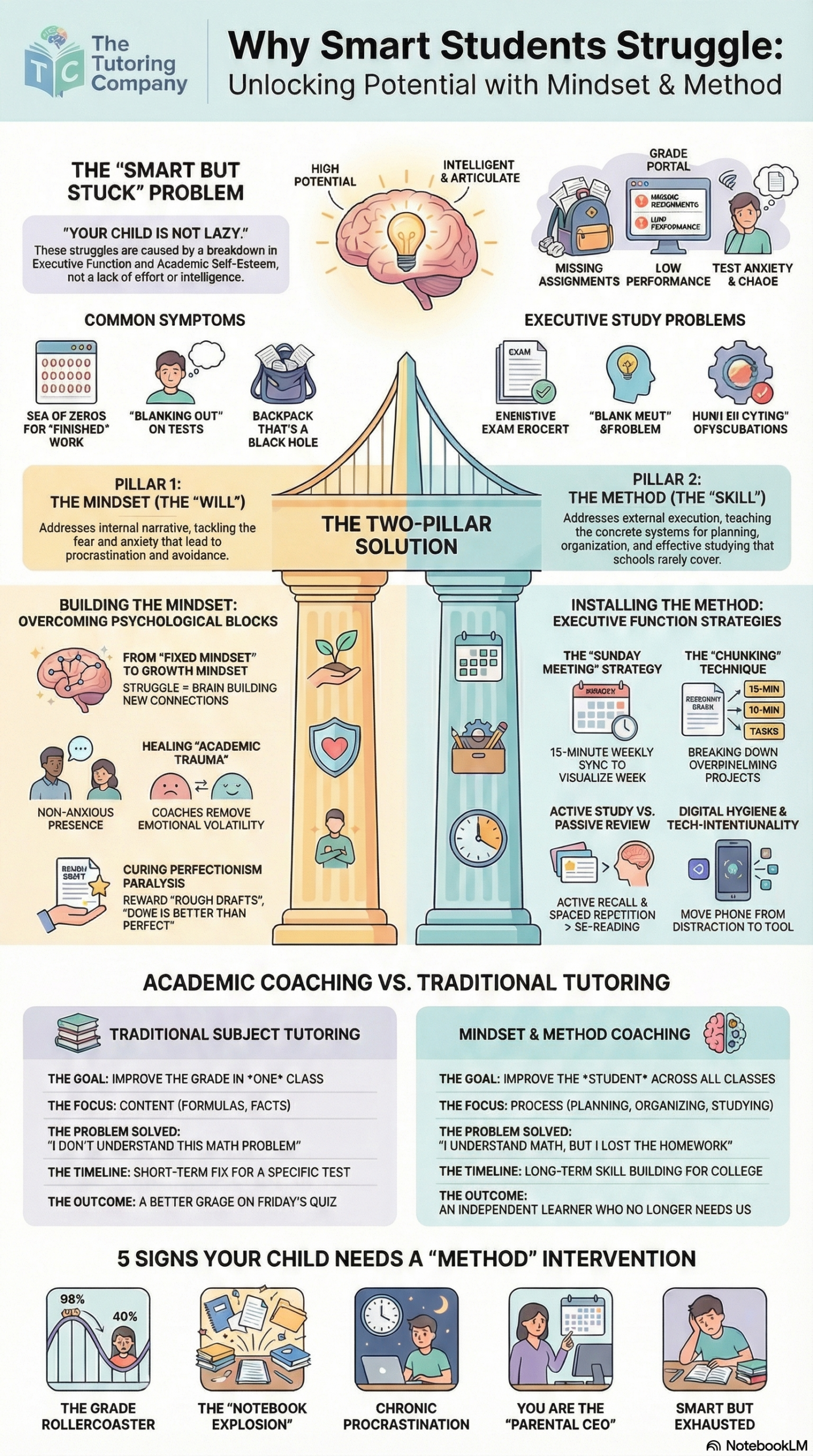
You are dealing with a breakdown in Executive Function and Academic Self-Esteem. Traditional “homework help” cannot fix this because the problem isn’t that they don’t understand the history lesson. The problem is that they lack the Mindset to approach the work with confidence and the Method to execute it without chaos.
This is why The Tutoring Company created Mindset & Method—a specialized service designed to bridge the gap between potential and performance.
Mindset vs. Method: The Missing Link in Education
Most tutoring services focus strictly on “Content.” They teach the math formula, the grammar rule, or the chemical equation. But for 60-70% of students, content is not the root issue. The issue is the process.
If a student understands Algebra but loses the worksheet, they fail. If a student writes a brilliant essay but is too anxious to turn it in, they fail.
Our philosophy treats the student as a whole person, not just a data point. We break academic success down into two non-negotiable pillars:
1. The Mindset (The “Will”)
This addresses the internal narrative.
-
Does your student believe they can learn?
-
Do they crumble under the slightest pressure?
-
Do they procrastinate because they are lazy, or because they are afraid of not being perfect?
2. The Method (The “Skill”)
This addresses the external execution.
-
Do they have a system for tracking deadlines?
-
Do they know how to take notes that are actually useful?
-
Do they know how to study for a test beyond just “re-reading”?
The Core Philosophy: You cannot fix a “Method” problem with “Mindset” pep talks, and you cannot fix a “Mindset” block with “Method” planners. You must address both simultaneously to see long-term change.
Part 1: The MINDSET (Psychology of Success)
Why do smart students procrastinate? It is rarely because they don’t want to do the work. It is almost always because the work causes them emotional pain.
When a student sits down to write an essay and feels a wave of anxiety (“I don’t know how to start,” “It won’t be good enough”), their brain triggers a Fight-or-Flight response. To the brain, that essay is a saber-toothed tiger. The logical response is Avoidance (Netflix, TikTok, Video Games).
Our coaches are trained to identify and dismantle these psychological blocks using three key concepts:
1. Breaking the “Fixed Mindset” Trap
Many high-performing students coasted through elementary school. Things came easily. Then, they hit a wall (usually in middle school or early high school). Because they never had to struggle to learn, they interpret this struggle as a lack of intelligence.
-
The Internal Monologue: “I have to try hard at this, therefore I must be stupid.”
-
The Shift: We teach them that struggle is not a sign of failure; it is the physiological feeling of a neuron building a connection.
2. Identifying “Academic Trauma”
If a student has been yelled at for grades, humiliated in class, or constantly compared to a sibling, they develop a physiological stress response to schoolwork.
-
Our Approach: We act as a “Non-Anxious Presence.” By removing the emotional volatility from homework time, we help the student’s nervous system down-regulate, allowing their logical brain (Prefrontal Cortex) to come back online.
3. Curing Perfectionism (Paralysis by Analysis)
Perfectionism is not about “high standards.” It is about fear. Many students would rather get a zero (by not turning it in) than get a C (by trying and failing). A zero protects their ego (“I didn’t try”), whereas a C hurts (“I tried and wasn’t good enough”).
-
The Fix: We reward “Rough Drafts.” We teach students that “done is better than perfect,” helping them push through the initial paralysis of starting.
Part 2: The METHOD (Executive Function Strategy)
Intelligence is the engine power. Executive Function is the steering wheel. Without it, you have a Ferrari driving in circles.
Our Method curriculum doesn’t just say “get organized.” We teach the specific, granular skills that schools assume students know but rarely teach explicitly.
1. The “Sunday Meeting” Strategy
Most disorganized students live in the “Now.” They cannot see Tuesday until it hits them in the face.
-
The Method: We teach a 15-minute sync on Sunday to visualize the week’s “landmines” (tests, big projects) and plan accordingly. This reduces the Monday morning panic.
2. The “Chunking” Technique
A “Research Paper” is a terrifying, impossible task for an ADHD brain.
-
The Method: We break it down into 12 distinct, non-scary tasks (e.g., “Find 3 sources,” “Write thesis statement,” “Draft intro”). A student can do a “15-minute task.” They cannot do a “Research Paper.” By crossing off small wins, we build momentum.
3. Active Study vs. Passive Review
Most students think “studying” means re-reading their notes (Passive). This is scientifically the least effective way to learn.
-
The Method: We teach Active Recall and Spaced Repetition. We teach students how to create their own practice tests and how to “teach back” the material, creating neural pathways that stick during the exam.
4. Digital Hygiene & Tech-Intentionality
We don’t just ban phones; we teach students how to live with them.
-
The Method: Teaching students how to use “Focus Modes,” how to set friction between themselves and their apps, and how to recognize when they are “doom scrolling” to avoid work. We move the phone from a distraction to a tool.
Academic Coaching vs. Traditional Tutoring: What’s the Difference?
Parents often ask, “Do I need a tutor or a coach?” The answer depends on the root cause of the struggle.
| Feature | Subject Tutoring | Mindset & Method (Coaching) |
| The Goal | Improve the grade in one class (e.g., Chemistry). | Improve the student across all classes. |
| The Focus | Content (Formulas, Dates, Facts). | Process (Planning, Organizing, Studying). |
| The Problem | “I don’t understand this math problem.” | “I lost my math homework.” |
| The Timeline | Short-term fix for a specific test. | Long-term skill building for college readiness. |
| The Outcome | A better grade on Friday’s quiz. | An independent learner who doesn’t need us anymore. |
The “Hybrid” Approach:
At The Tutoring Company, our services often blend both. We might use a Math Tutoring assignment as the vehicle to teach organization skills. We help them finish the homework (Tutoring), but we do it by teaching them how to break it down and manage their time (Coaching).
Signs Your Child Needs a “Method” Intervention
If you see these red flags, “more studying” will not help. You need a structural intervention.
-
The Rollercoaster Grades: A student who gets a 98% on one test and a 40% on the next (usually due to a missing assignment or forgetting the test existed).
-
The “Notebook Explosion”: Papers are jammed into the bottom of the bag, no dates on notes, and they can never find what they need in under 60 seconds.
-
Chronic Procrastination: They start big projects at 10:00 PM the night before they are due, leading to tears and family fights.
-
The “Parental CEO”: You are the one checking the portal. You are the one remembering deadlines. If you stopped reminding them, they would fail. (This is dangerous for college readiness).
-
Smart but Exhausted: They are working hard, but working inefficiently. They spend 3 hours “studying” but only get 20 minutes of real work done due to distractions.
The Tutoring Company Difference: How We Fix It
We don’t believe in cookie-cutter solutions. Your child’s brain is unique, and their coaching plan should be too.
1. The Student Profiler
Before we ever open a textbook, we use our proprietary matching system to pair your student with a mentor who fits their personality.
-
Does your child need a cheerleader?
-
Do they need a firm taskmaster?
- Do they need a “cool older sibling” vibe?Relationship is the foundation of learning. If they don’t like their coach, they won’t buy into the Method.
2. Modified Peer Tutoring
We hire the best and brightest university students (from UF, Embry-Riddle, etc.) who are relatable.
-
Why it works: When a parent says, “You need to use a planner,” it sounds like nagging. When a cool, successful college student says, “Hey, this planner is the only reason I passed Calculus,” it sounds like insider advice.
3. The Goal is “Firing Ourselves”
Our ultimate goal is independence. We want to build the scaffolding, teach the student how to climb, and then slowly remove the support until they are doing it on their own.
Frequently Asked Questions (Q&A)
Q: Is “Mindset & Method” only for students with ADHD?
A: No. While this program is incredibly effective for students with ADHD or Executive Function Disorder, it is designed for any student who is “smart but scattered.” Many of our students have no diagnosis but struggle with the transition to the higher workload of middle school, high school, or the IB/Cambridge programs.
Q: How long does it take to see results?
A: “Method” changes (organization) can happen in weeks. “Mindset” changes (confidence) take longer. Typically, parents see a reduction in household stress within the first month, with grade improvements following shortly after as the missing assignments decrease.
Q: Can you do this online?
A: Yes. We offer individualized tutoring that utilizes screen sharing to help students organize their digital lives (portals, files, calendars) just as effectively as in-person coaching.
Q: My child refuses to use a planner. Can you help?
A: Absolutely. Most students hate planners because they have been taught to use them incorrectly (as a historical record of what they did, rather than a tool for what they need to do). We test different systems—paper, apps, wall calendars—until we find the one that fits their brain.
Ready to Stop the Homework Battle?
If you are tired of being the “Homework Police,” it is time to outsource the enforcement to a professional who can build the skills your child is missing.
Mindset & Method isn’t just about saving this semester’s GPA. It’s about giving your student the executive function skills they will use in college, their career, and the rest of their life.
Contact Us Today for a Free Consultation
Let’s build a plan that turns your “Smart but Scattered” student into a “Confident & Capable” learner.