
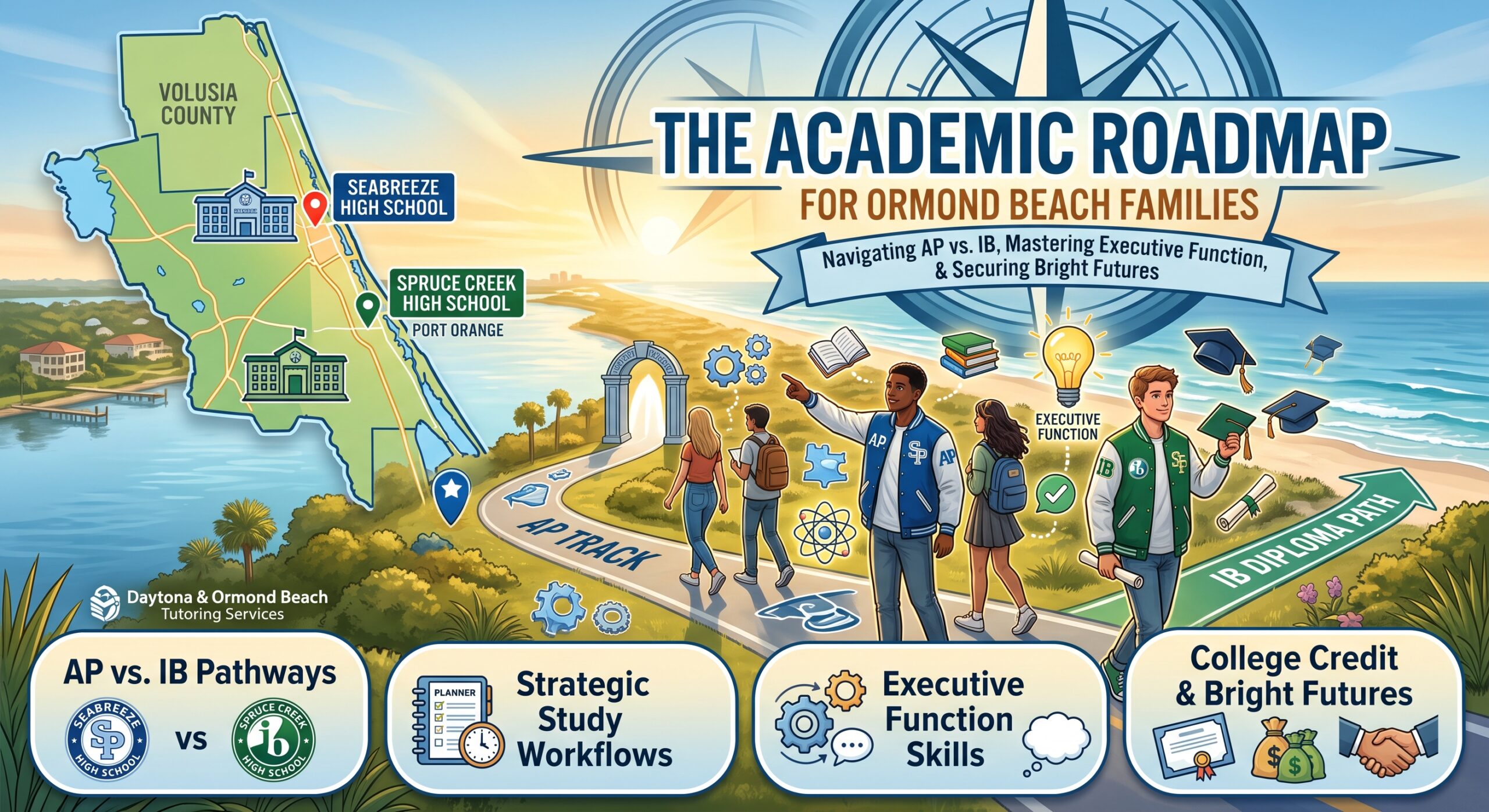
TL;DR: The Academic Roadmap for Ormond Beach Families
Advanced high school coursework in Volusia County demands a major transition from middle school memorization to disciplined executive function systems. Whether managing modular AP courses at Seabreeze High School or the full IB Diploma at Spruce Creek High School, students must shift from reactive cramming to proactive weekly syllabus audits, timed retrieval practice, and early content intervention. Implementing structured workflows preserves GPAs, secures Florida Bright Futures qualifications, and prevents late-night academic burnout.
In Volusia County, taking on an AP-heavy schedule or an IB diploma track is not merely about managing more homework. It demands an advanced approach to how students process abstract concepts, write analytical arguments under tight time constraints, organize weekly deadlines, and retain cumulative material across nine full months. Without deliberate study habits, even learners who earned effortless straight A’s in middle school often encounter late-night cramming, elevated stress, and slipping grades.
This comprehensive guide details the programmatic landscapes of AP and IB in our local area, explains why traditional study approaches fail in advanced classes, and outlines a structured, step-by-step roadmap for mastering challenging coursework while preserving balance.
Volusia County Academic Pathways: AP at Seabreeze vs. IB at Spruce Creek
Ormond Beach families navigating upper-level academics generally choose between two premier rigorous paths: subject-specific Advanced Placement (AP) tracks or the fully integrated International Baccalaureate (IB) Diploma framework.
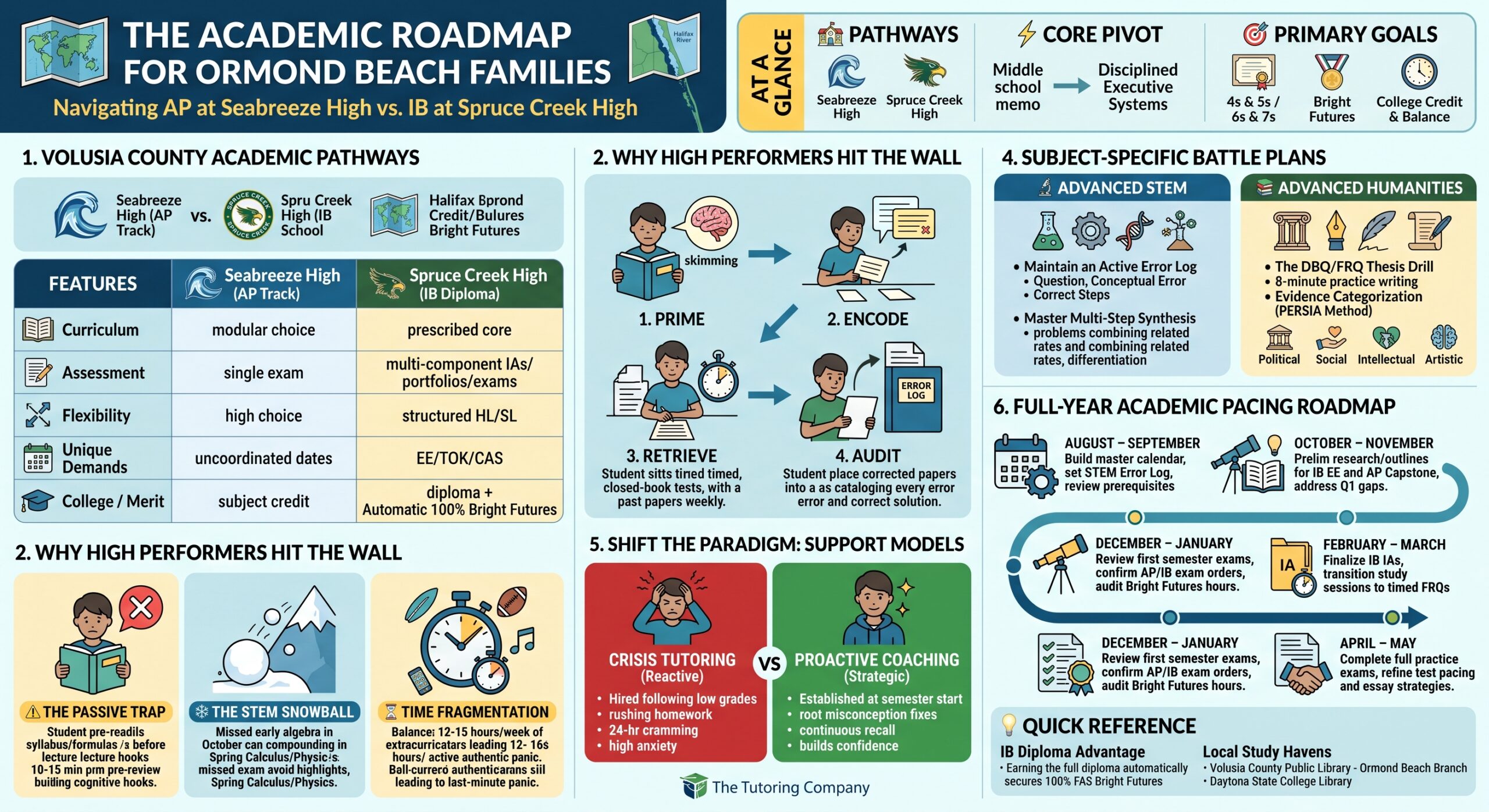
- Curriculum Model: Independent, modular course selection
- Evaluation: Single cumulative exam in May (Scores 1–5)
- Flexibility: High; customize by subject strength
- College Credit: Subject-by-subject transfer credits via AP Central
- Core Challenge: Uncoordinated deadlines across multiple AP teachers
- Curriculum Model: Prescribed 6-subject interdisciplinary core
- Evaluation: Exams, Internal Assessments (IAs), & Portfolios
- Flexibility: Structured Higher Level (HL) & Standard Level (SL)
- College Credit: Comprehensive diploma credit + automatic Bright Futures
- Core Challenge: Massive multi-year independent deliverables (EE & TOK)
1. The Advanced Placement (AP) Ecosystem at Seabreeze High School
Administered nationwide by the College Board AP Central, the AP curriculum enables students to focus heavily on specific areas of strength. At Seabreeze High School, ambitious learners can construct custom schedules emphasizing advanced STEM subjects (such as AP Calculus BC, AP Physics C, and AP Chemistry) or humanities disciplines (including AP Seminar, AP Research, AP U.S. History, and AP English Literature).
The primary advantage of the AP pathway is schedule agility. A student can enroll in two AP courses during sophomore year and scale up to four or five in junior year without committing to an interconnected diploma requirement. However, because each course operates independently, students frequently encounter uncoordinated schedules where major unit exams collide on the exact same morning.
Scoring a 4 or 5 earns valuable college credit and raises weighted GPAs for state-funded scholarship opportunities. If your student is aligning their coursework with merit scholarship criteria, read our complete guide on Navigating the Florida Bright Futures Requirements.
2. The International Baccalaureate (IB) Programme at Spruce Creek High School
Recognized as one of Central Florida’s premier academic magnet programs, the Volusia County Schools IB Program at Spruce Creek High School follows the global framework developed by the International Baccalaureate Organization (IBO). Unlike modular AP tracks, IB is a comprehensive, multi-year curriculum.
Students must take coursework across six distinct academic disciplines concurrently, balancing Higher Level (HL) and Standard Level (SL) subjects while finishing major independent academic deliverables:
- Internal Assessments (IAs): In-depth research papers and lab portfolios written for individual subjects, graded by school faculty, and audited internationally.
- The Extended Essay (EE): A rigorous 4,000-word independent research paper completed across the junior and senior years with faculty mentorship.
- Theory of Knowledge (TOK): An interdisciplinary course examining how truth and evidence are validated across mathematics, sciences, and the arts.
- Creativity, Activity, Service (CAS): Structured extracurricular participation promoting service, personal growth, and balance outside of classes.
Why High-Performing Ormond Beach Students Hit Academic Roadblocks
Many students entering ninth or tenth grade in advanced tracks expect to earn top grades simply by paying attention in class and reviewing notes right before tests. In AP and IB coursework, this approach quickly breaks down due to three structural friction points:
-
1
Cumulative Knowledge Deficits
Unresolved algebra or science concepts from September snowball into severe failures during complex spring calculus and physics units.
-
2
Schedule & Time Fragmentation
Open-ended projects (EEs, IAs, DBQs) are constantly postponed by daily assignments, varsity athletics, and local extracurriculars.
-
3
The Passive Study Trap
Re-reading highlighted notes builds an illusion of mastery that falters under timed, multi-source analytical exam conditions.
1. The Cumulative Snowball in STEM Courses
Standard high school subjects are often modular. In AP Calculus, AP Chemistry, and IB Analysis & Approaches, material is strictly cumulative. If a student misses core fundamentals in polynomial functions or chemical nomenclature during October, they cannot start fresh in November. By the time related units arrive in the spring semester, early knowledge gaps cause widespread confusion.
2. Extracurricular Overload and Competing Deadlines
Ormond Beach high schoolers are actively involved outside the classroom—competing on varsity sports teams, training in surf and swim programs, performing in the Seabreeze Marching 100, and volunteering in local community programs. When a student devotes 12 to 15 hours each week to activities, unstructured assignments with distant deadlines (such as draft revisions for an IB Extended Essay or weekly AP reading journals) get delayed until the final night.
3. Passive Review vs. Active Synthesis
AP and IB assessments test analysis and execution rather than fact memorization. An AP History Document-Based Question (DBQ) requires students to integrate seven separate primary sources into an analytical argument in 45 minutes. An IB Chemistry exam asks students to interpret unfamiliar experimental data sets. Skimming highlighted passages builds familiarity, but fails to build the active recall needed to perform on exam day.
Strategic Study Workflows for AP & IB Subject Mastery
Top students do not necessarily spend twice as many hours studying; they use organized systems that eliminate wasted effort. Adopting consistent executive function workflows allows high schoolers to stay ahead of rapid coursework pacing.
1. Prime
Pre-read syllabus terms & formulas before the classroom lecture.
2. Encode
Convert lecture notes into active question-and-answer flashcards.
3. Retrieve
Solve timed, closed-book FRQs and past papers weekly.
4. Audit
Catalog every missed question in a dedicated error analysis binder.
Developing disciplined planning routines early prevents chronic stress during exam season. For a complete guide to organizational strategies and study habits, read our article on Developing Executive Function Skills in High School Students.
Active Practice Repositories and Local Study Havens
Effective exam prep requires testing knowledge with authentic, timed questions. Students should take advantage of trusted question banks like the Khan Academy AP Course Directory to practice exercises with immediate answer explanations.
Setting up a distraction-free study environment is just as important. When studying at home becomes difficult, Ormond Beach students benefit from quiet study areas like the Volusia County Public Library – Ormond Beach Branch on South Beach Street or the campus library facilities at Daytona State College.
Subject-Specific Strategies: STEM vs. Advanced Humanities
Success in advanced courses requires applying distinct study methods matched to each discipline’s specific cognitive demands.
1. STEM Mastery (AP Calculus, AP Physics, AP Chem, IB Math AA/AI)
- Maintain an Active Error Log: For every incorrect homework or quiz problem, write down: 1) the question, 2) the conceptual error made, and 3) the correct step-by-step solution. Review this binder prior to every unit exam.
- Master Multi-Step Synthesis: Standard tests evaluate single formulas; AP and IB exams combine two or three distinct concepts within a single problem (e.g., combining related rates with implicit differentiation).
2. Humanities & Social Sciences (AP Literature, AP Gov, AP US History, IB History)
- The DBQ/FRQ Thesis Drill: Practice writing introductory paragraphs with a defensible thesis statement and contextualization within an 8-minute time limit.
- Evidence Categorization (PERSIA Method): Group historical evidence by Political, Economic, Religious, Social, Intellectual, and Artistic themes to quickly outline essays from memory.
Crisis Tutoring vs. Proactive Academic Coaching
Many families search for tutoring only after a difficult report card or a low test grade. In rigorous courses, waiting for an academic crisis leads to unnecessary stress and forces students into temporary catch-up mode. Proactive coaching provides structured, ongoing guidance instead.
| Focus Dimension | Traditional “Crisis” Tutoring | Proactive Academic Coaching |
|---|---|---|
| Trigger Point | Hired reactively following a failing grade or midterm warning. | Established at semester start to master concepts before difficulty escalates. |
| Session Focus | Rushing to complete immediate homework assignments for quick points. | Identifying root misconceptions and building long-term retention frameworks. |
| Executive Skills | Limited to basic homework help with zero weekly calendar audits. | Integrates structured weekly planning, syllabus scheduling, and task management. |
| Exam Preparation | Short-term cramming 24 hours prior to exams, yielding poor retention. | Continuous active recall, spaced review, and timed practice with authentic rubrics. |
| Student Mindset | High test anxiety, reactive stress, and dependency on external help. | Academic confidence, disciplined study habits, and independent learning skills. |
At The Tutoring Company, our approach matches Ormond Beach students with dedicated subject specialists who understand the academic standards of Volusia County classrooms. Whether your student needs specialized support in Calculus and STEM Tutoring, assistance with analytical essay writing, or comprehensive SAT and ACT Test Preparation to pair with their GPA, our mentors teach students how to think critically and study with confidence.
To learn how early coaching supports long-term high school success, explore our article on How Early Academic Intervention Prevents High School Burnout.
Full-Year Academic Pacing Calendar for Ormond Beach Families
Your Semester-by-Semester Success Checklist
- August – September: Build a master calendar across all classes. Set up a dedicated STEM Error Log binder. Review prerequisite skills for advanced math and science.
- October – November: Complete preliminary research and outlines for IB Extended Essays and AP Capstone assignments. Address first-quarter concept gaps immediately.
- December – January: Review first-semester cumulative exams. Confirm spring AP and IB exam registrations, and audit Bright Futures volunteer hours.
- February – March: Finalize IB Internal Assessments and submit portfolios. Transition weekly study sessions to timed, closed-book Free Response Questions (FRQs).
- April – May: Complete full-length practice exams under realistic timing. Refine test pacing and essay strategies to maximize final composite scores.
Excelling in AP courses at Seabreeze High School or the IB Diploma Programme at Spruce Creek High School does not require sacrificing personal life, athletics, or rest. By using consistent weekly planning routines, active study strategies, and expert academic coaching, Ormond Beach students can achieve top test scores, earn valuable college credits, and build strong academic confidence.
Explore our personalized private tutoring services by visiting our Daytona and Ormond Beach Tutoring Services page.
Frequently Asked Questions (FAQ)
Students who earn the full IB Diploma automatically qualify for the 100% Florida Academic Scholars (FAS) award under Florida Bright Futures, without needing to meet standard SAT/ACT score thresholds, provided they fulfill the required community service hours.
Students attending Seabreeze High School primarily take standalone AP and Dual Enrollment courses. Spruce Creek IB students follow a prescribed IB curriculum, but many choose to take corresponding AP exams in May to maximize potential college credit transfers.
Proactive tutoring is most effective when started early in the semester or as soon as a challenging new unit begins (such as Calculus derivatives or AP Chemistry equilibrium). Starting early prevents cumulative knowledge gaps and avoids stressful last-minute cramming.
We offer both in-home tutoring throughout Ormond Beach (including beachside neighborhoods, Breakaway Trails, and Plantation Bay) and one-on-one virtual instruction, as well as sessions held in quiet community spaces like the Ormond Beach Public Library.